Overview
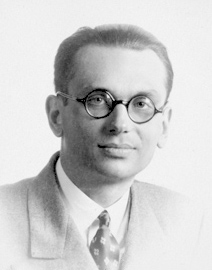
Kurt Friedrich Gödel (1906-1978) stands as one of the towering figures in the history of logic, transforming mathematics from within by proving that mathematical truth transcends formal proof. His 1931 incompleteness theorems shattered the dream—pursued by mathematicians since Euclid—of a complete, consistent, and decidable foundation for all mathematics. Working with pencil and paper in Vienna cafés, Gödel showed that any formal system rich enough to express basic arithmetic must contain undecidable propositions: statements that are true but unprovable inside the system. This result, once described as “the greatest mathematical discovery of the century,” ended Hilbert’s program for a single axiomatic basis of mathematics and established Gödel alongside Aristotle and Frege in the pantheon of logic.Beyond incompleteness, Gödel produced landmark results on the consistency of the Axiom of Choice and the Continuum Hypothesis with the Zermelo-Fraenkel axioms, invented the constructive notion of Gödel numbering that translates syntax into arithmetic, and formulated the Gödel metric in general relativity—permitting exotic solutions with closed timelike curves. His philosophical writings on mathematical Platonism, time, and the mind–machine question continue to influence mathematicians, computer scientists, and philosophers.
History/Background
Gödel was born on 28 April 1906 in Brünn, Moravia (now Brno, Czech Republic), then part of the Austro-Hungarian Empire. After completing a doctorate at the University of Vienna in 1930 under Hans Hahn, he joined the Institute for Advanced Study in Princeton during three visits (1933-34, 1935, 1939-40) and finally emigrated permanently in 1940 to escape World War II. He became a permanent member of the Institute in 1946 and retired as Professor Emeritus in 1976. Key milestones:- 1930: Completes dissertation proving completeness of first-order logic (Gödel’s completeness theorem).
- 1931: Publishes “Über formal unentscheidbare Sätze…” introducing the incompleteness theorems.
- 1938: Proves relative consistency of the Axiom of Choice and the Continuum Hypothesis.
- 1940: Arrives in Princeton; befriends Einstein and von Neumann.
- 1949: Discovers rotating solutions to Einstein’s field equations allowing time-like loops.
- 1978: Dies in Princeton from malnutrition caused by paranoid refusal to eat.
Key Information
Incompleteness Theorems Let PA denote Peano Arithmetic. Gödel constructed, via Gödel numbering, a sentence G that asserts “G is not provable in PA.” - If PA is consistent, then ⊬ G (G is unprovable), hence G is true. - If PA proves ¬G, then PA proves G, contradicting consistency. Thus, assuming consistency, PA cannot decide G. The second incompleteness theorem shows Con(PA) (the formal statement of PA’s consistency) is itself unprovable in PA, scuttling Hilbert’s finitary consistency program.Constructible Universe L
Gödel defined the constructible hierarchy
L₀ = ∅, L_{α+1} = Def(L_α), L_λ = ∪_{α<λ} L_α for limit λ,
and showed the universe V = L implies both AC and GCH, establishing their consistency relative to ZF.
Gödel Numbering
A primitive recursive injection ⌜φ⌝ from formulas to natural numbers, letting metamathematical predicates (e.g., “is a proof”) become arithmetic. This self-referential apparatus underlies modern coding techniques in logic and computer science.
Einstein–Gödel Metric
ds² = −dt² + dx² + dy² + dz² + (2ω/m)(dt − dz)²
describes a rotating universe with closed timelike curves, illustrating Gödel’s fascination with time’s nature.