




Overview
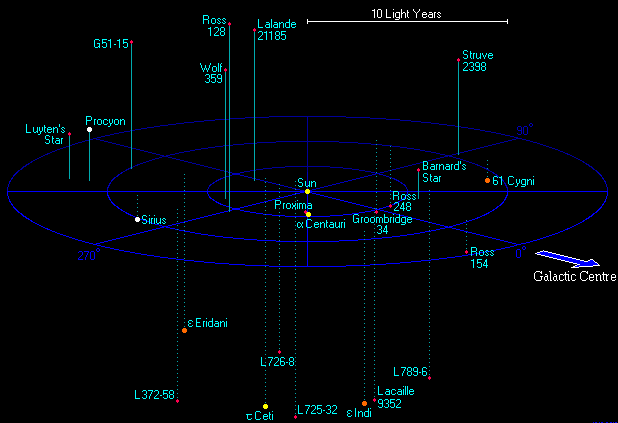
A light-year is a unit of length, not time, used to express astronomical distances. It represents the distance that light—traveling at approximately 299,792 kilometers per second—covers in one Julian year (365.25 days). This unit is indispensable for measuring the immense scales of the universe, where distances in kilometers or miles become unwieldy. For example, the nearest star to the Sun, Proxima Centauri, lies 4.24 light-years away, while the Milky Way galaxy spans about 100,000 light-years. Light-years help contextualize the universe’s vastness, making it easier for scientists and the public to grasp cosmic proportions.The term emerged as astronomers realized the finite speed of light and its implications for observing distant objects. When we see light from a star 1,000 light-years away, we’re effectively seeing it as it appeared 1,000 years ago. This concept ties light-years to both distance and time, offering a unique lens through which to study the universe’s history.
History/Background
The concept of a light-year originated in the 17th century when Danish astronomer Ole Rømer demonstrated that light has a finite speed by observing Jupiter’s moons. However, the term "light-year" itself was coined in the 19th century. German astronomer Friedrich Bessel is credited with first using the term in 1838 when he measured the distance to the star 61 Cygni using parallax, expressing it in light-years. This marked a pivotal shift in how astronomers communicated distances to the public.The International Astronomical Union (IAU) formalized the definition in 1958, specifying a light-year as the distance light travels in a Julian year (exactly 365.25 days). This standardization ensured consistency across scientific measurements. While parsecs (1 pc ≈ 3.26 light-years) remain the preferred unit in professional astronomy, light-years dominate public discourse due to their intuitive connection to time and relatability.
Key Information
- Distance: 1 light-year = 9,460,730,472,580.8 km (≈9.46 trillion km or 5.88 trillion miles). - Speed of Light: 299,792 km/s in a vacuum. - Julian Year: A standardized time unit of 365.25 days used in astronomical calculations. - Comparisons: - 1 parsec ≈ 3.26 light-years. - The observable universe is about 93 billion light-years in diameter. - Common Uses: Measuring distances to stars, galaxies, and other celestial objects.Significance
Light-years are foundational to modern astronomy, enabling the quantification of cosmic scales that would otherwise be abstract. They bridge the gap between scientific precision and public understanding, making concepts like the expansion of the universe or the age of distant galaxies more tangible. For instance, the Hubble Space Telescope often observes objects billions of light-years away, revealing the universe’s early history.Additionally, light-years underscore the time it takes for light to traverse space, meaning observations of distant objects are inherently glimpses into the past. This temporal dimension is critical for studying cosmic evolution, dark matter, and the search for extraterrestrial life. The unit also highlights humanity’s small place in the cosmos, fostering awe and curiosity about the universe’s mysteries.



