




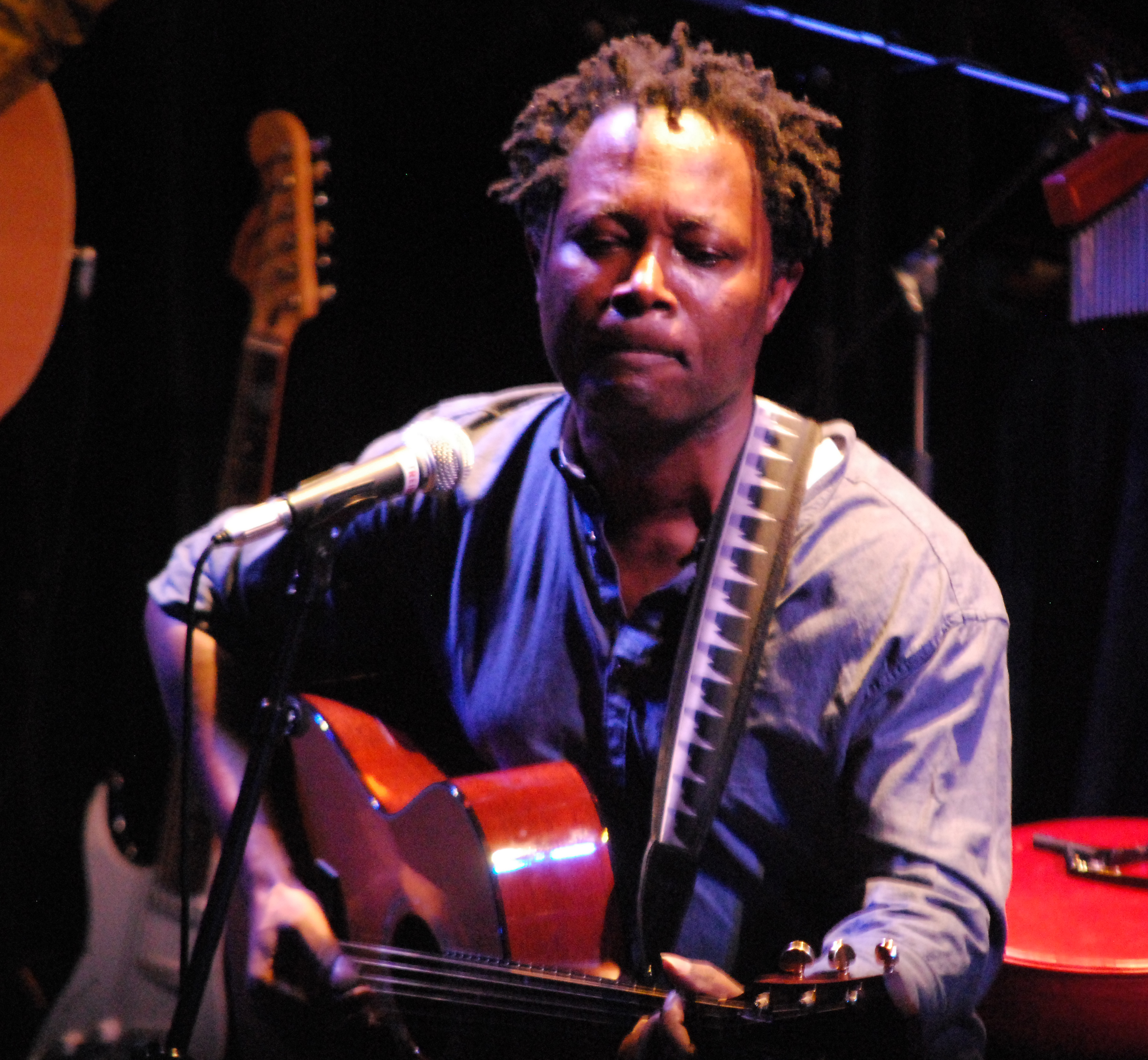
Lokya Kanza is a Congolese singer, songwriter, arranger, producer, philanthropist, television personality, and multi‑instrumentalist whose work blends African folk traditions with contemporary pop sensibilities. Born in the Democratic Republic of the Congo, Kanza sings in French, Swahili, Lingala, Portuguese, English and Wolof, allowing him to reach diverse audiences across the African continent and beyond. He first gained international attention in the early 1990s with a series of critically acclaimed albums that contrasted the dance‑floor‑oriented rumba popular in Central Africa with a more introspective, acoustic‑driven sound. From 2016 to 2017 he served on the coaching panel of The Voice Afrique Francophone, further cementing his status as a cultural ambassador and mentor to emerging talent.
Kanza’s career spans over three decades, during which he has released ten studio albums, collaborated with artists such as Salif Keita, Angélique Kidjo and Manu Chao, and contributed to numerous film soundtracks. His philanthropic initiatives focus on music education for under‑privileged youth in Kinshasa and the promotion of cultural exchange programs throughout West and Central Africa. In addition to his recording and performance activities, Kanza has become a familiar face on African television, appearing as a judge, host and guest on a variety of music‑related programs.
The following sections examine Kanza’s early life, musical development, stylistic characteristics, television work, philanthropic endeavors, discography and the critical reception of his oeuvre.
Early life and education
Pascal Lokua Kanza was born in Kinshasa, then part of Zaire, into a family with deep musical roots; his father was a church organist and his mother a traditional singer. Exposed to liturgical music, Congolese rumba, and the folk songs of neighboring regions, Kanza began studying piano at age six and later learned guitar, bass, and percussion. He attended the National Institute of Arts in Kinshasa, where he studied music theory, composition and arrangement. During his teenage years he performed with local church choirs and small ensembles, honing his vocal technique and developing fluency in several languages spoken in the region.In the late 1970s, Kanza traveled to France to pursue higher education in ethnomusicology at the University of Paris VIII. The experience broadened his exposure to European folk traditions and contemporary world‑music movements, influencing his later decision to fuse African melodic structures with acoustic guitar‑driven arrangements. While in Paris, he performed in cafés and cultural festivals, establishing connections with African diaspora musicians and producers who would later become collaborators.
Musical career
Early recordings (1990–1995)
Kanza’s debut album, Mokonzi (1990), was recorded in Paris with a modest ensemble of Congolese and French musicians. The record featured original compositions sung primarily in Lingala and French, and it received praise for its lyrical depth and restrained instrumentation. Critics highlighted the album’s departure from the high‑energy rumba that dominated Congolian airwaves, noting Kanza’s “soulful, folk‑like” approach as a refreshing alternative.The follow‑up, Lokua Kanza (1993), solidified his reputation as a cross‑cultural artist. The album incorporated Swahili and Portuguese verses, reflecting Kanza’s interest in East African and Lusophone musical traditions. Its lead single, “Mobali,” achieved radio play in both Francophone and Lusophone African markets, and the record earned a nomination for Best World Music Album at the 1994 Victoires de la Musique.
International breakthrough (1996–2005)
Kanza’s third studio effort, Wapi Yo? (1996), marked his first collaboration with the renowned French label Sony Music France. The album’s polished production, combined with Kanza’s intimate songwriting, attracted attention from European world‑music festivals such as WOMAD and the Festival des Vieilles Charrues. In 1998, he embarked on a European tour that included performances at the Royal Albert Hall and the Olympia in Paris, exposing his music to a broader audience.During this period Kanza also contributed to film soundtracks, most notably the 1999 French‑Congolese co‑production La Vie est Belle, for which he composed and performed the title track. The song’s success earned him a César Award nomination for Best Original Song, further raising his profile in the French entertainment industry.
Mature period and collaborations (2006–present)
The release of Koïla (2006) signaled a mature phase in Kanza’s career. The album featured collaborations with Salif Keita (vocals on “Maman”) and Angélique Kidjo (duet on “Sahara”). Critics praised the seamless integration of West African vocal styles with Kanza’s Central African roots, describing the work as “a pan‑African tapestry of sound.”In 2012 Kanza issued Moko, an album that explored themes of migration, identity and social justice. The record incorporated field recordings from refugee camps in Rwanda and Guinea, and it was accompanied by a documentary film that highlighted the humanitarian crises in the Great Lakes region. The project earned the 2013 African Music Award for Best Socially Conscious Album.
Kanza’s most recent studio effort, Bamako (2021), was recorded in Mali with members of the Afro‑jazz collective Tinariwen. The album’s blend of desert blues, Congolese folk, and contemporary pop elements demonstrated Kanza’s continued willingness to experiment with genre boundaries while maintaining his signature lyrical intimacy.
Musical style and influences
Kanza’s music is characterized by acoustic guitar‑driven arrangements, subtle percussion, and layered vocal harmonies. Unlike the high‑tempo, brass‑heavy African rumba that dominates much of Central African popular music, his compositions often employ slower tempos, minor tonalities, and introspective lyricism. He frequently utilizes modal scales derived from traditional Congolese music, interwoven with Western folk chord progressions.Lyrically, Kanza addresses personal and societal themes, ranging from love and spirituality to political commentary. His multilingual approach enables him to tailor songs to specific cultural contexts; for instance, his Swahili pieces often reference East African proverbs, while his Portuguese tracks draw on Lusophone poetic forms.
Influences cited by Kanza include Congolese legends such as Tabu Ley Rochereau, Western folk artists like James Taylor, and African griot traditions. He has also acknowledged the impact of jazz improvisation on his guitar work, particularly the modal explorations of Miles Davis’s Kind of Blue era.
Television work and mentorship
From 2016 to 2017 Kanza served as a coach on The Voice Afrique Francophone, the French‑language version of the international singing competition franchise. His tenure was marked by a focus on vocal technique, emotional authenticity, and the importance of cultural heritage in contemporary performance. Two of his team members, Aïcha Moussa and Jean‑Baptiste N’Goma, reached the final round, underscoring his effectiveness as a mentor.Beyond The Voice, Kanza has appeared as a guest judge on the Congolese talent show Mosaïque and hosted a documentary series titled Rythmes d’Afrique (2019), which explored traditional music practices across the continent. His television presence has contributed to a broader public awareness of African musical diversity and has positioned him as a bridge between established artists and emerging talent.
Philanthropy and cultural advocacy
Kanza’s philanthropic activities center on music education and cultural preservation. In 2008 he founded the Lokua Kanza Music Academy in Kinshasa, a nonprofit organization that provides free instrumental instruction, songwriting workshops, and recording opportunities to children from low‑income neighborhoods. By 2022 the academy had served over 3,500 participants and facilitated the release of a compilation album featuring student performances.He has also partnered with UNESCO’s Intangible Cultural Heritage program, advocating for the documentation and transmission of traditional Congolese songs. In 2015 Kanza organized the Festival des Voix Ancestrales, a week‑long event that brought together elder musicians from rural communities to perform alongside contemporary artists, fostering intergenerational dialogue.
Kanza’s humanitarian work extends to health initiatives; he has served as an ambassador for the World Health Organization’s campaign against malaria in Central Africa, using his platform to promote preventive measures and distribute insecticide‑treated nets in rural districts.
Discography
- Mokonzi (1990) - Lokua Kanza (1993) - Wapi Yo? (1996) - Koïla (2006) - Moko (2012) - Bamako (2021)In addition to these studio albums, Kanza has contributed to numerous compilations, soundtracks and collaborative projects, including the 1999 film La Vie est Belle (soundtrack) and the 2008 tribute album Voices of Africa (guest appearance).
Awards and recognition
- Victoires de la Musique nomination, Best World Music Album (1994) - César Award nomination, Best Original Song for “Maman” (1999) - African Music Award, Best Socially Conscious Album for Moko (2013) - Chevalier de l’Ordre des Arts et des Lettres, France (2015) - UNESCO Artist for Peace designation (2018)These honors reflect Kanza’s artistic excellence, social engagement and contributions to cultural diplomacy.







