Overview
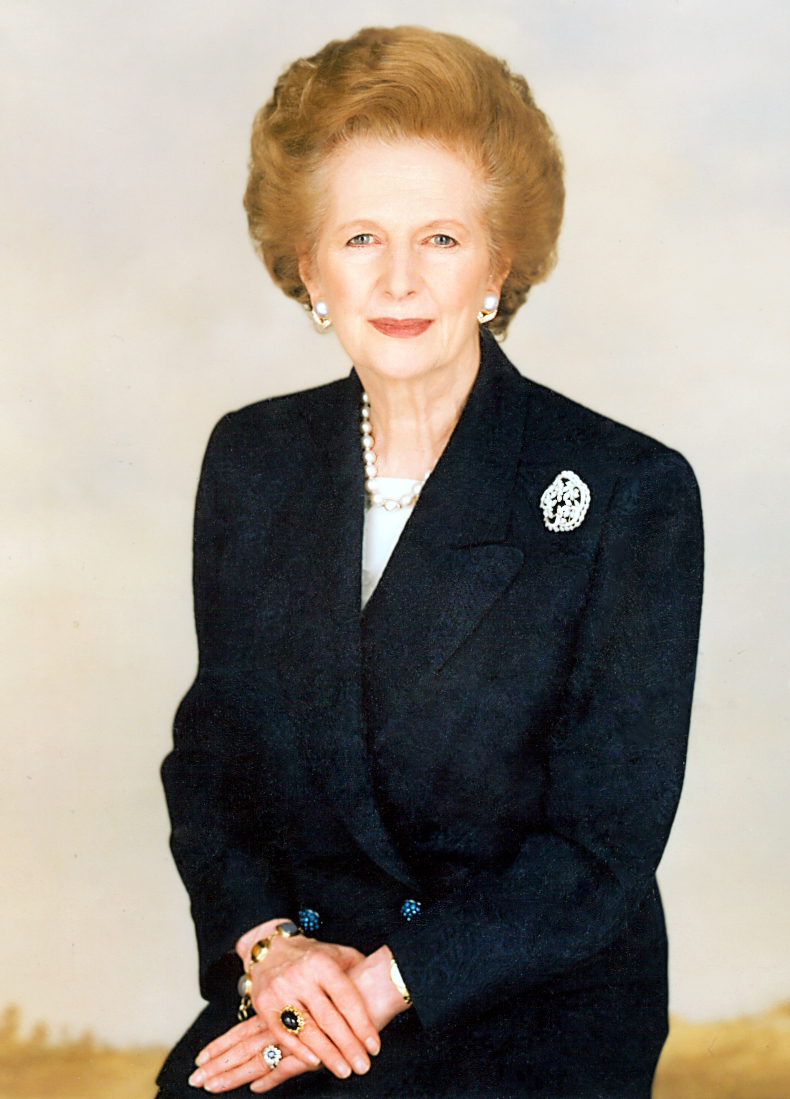
Margaret Hilda Thatcher, Baroness Thatcher (1925-2013), remains the most influential—and divisive—British political figure since Winston Churchill. Rising from a provincial grocer’s shop to 10 Downing Street, she fused Victorian moral certitude with neo-liberal economics to dismantle the post-war consensus of managed capitalism and strong trade unions. Her governments privatised state industries, deregulated the City, sold council houses to tenants, and projected military power in the Falklands War, thereby forging a new model of governance copied worldwide. Supporters credit her with saving Britain from economic decline; critics accuse her of entrenching inequality and shredding social solidarity. Either way, “Thatcherism” became shorthand for a seismic shift in Western politics toward markets, individualism, and assertive statecraft.
History/Background
Born in Grantham, Lincolnshire, on 13 October 1925, Margaret Roberts imbibed thrift, Methodism, and self-help from her shopkeeper father, who served as local mayor. A scholarship girl at Oxford (Chemistry, Somerville College), she entered politics after wartime research work, fighting her first parliamentary seat in 1950. In 1951 she married Denis Thatcher, a prosperous businessman whose income freed her to pursue a political career while raising twins, Carol and Mark. Elected MP for Finchley in 1959, she rose rapidly through Conservative ranks, serving as Education Secretary (1970-74) under Edward Heath. After two general-election defeats, the party turned to Thatcher in 1975, making her the first woman to lead a major British party. Four years of industrial unrest, IMF bail-outs, and rising inflation discredited Labour, allowing Thatcher to win the 1979 general election and begin her transformative premiership.
Key milestones followed: the 1981 budget that defied Keynesian orthodoxy by raising taxes amid recession; the 1982 Falklands War that restored patriotic morale; the 1984-85 miners’ strike that broke the National Union of Mineworkers; the 1986 “Big Bang” deregulation of financial markets; the 1987 third election victory; and the 1989 poll-tax debacle that triggered her ousting by Conservative MPs in November 1990. Elevated to the House of Lords as Baroness Thatcher of Kesteven, she spent her later years lecturing globally, mentoring right-wing politicians, and defending her legacy until strokes silenced her public voice.
Key Information
-
Economic Reforms: Privatised gas, telecoms, steel, cars, buses, water, electricity; cut top income-tax rate from 83 % to 40 %; curbed union power through successive Employment Acts; promoted home ownership by selling 1.5 million council houses.
-
Foreign Policy: Led task force to reclaim the Falkland Islands after Argentine invasion (1982); allowed US cruise missiles at Greenham Common; championed NATO deployment of Pershing II missiles; signed Single European Act (1986) while resisting deeper EU integration; cultivated special relationship with Ronald Reagan, backing SDI and bombing of Libya (1986).
-
Social Impact: Manufacturing employment fell by 2 million; North-South divide widened; service-sector and financial jobs boomed in London; riots in Brixton, Toxteth, and Toxteth (1981) exposed racial and urban tensions; “Loadsamoney” culture celebrated wealth creation while homelessness rose.
-
Political Style: Centralised decision-making in Downing Street; used cabinet reshuffles to enforce loyalty; employed military metaphors (“enemy within” for miners); relied on advisers like Sir Alan Walters (economics) and Bernard Ingham (press); famously declared “The lady’s not for turning” at 1980 Conservative conference.
-
Global Influence: Inspired Reagan, Kohl, and emerging Eastern European liberals; provided ideological template for IMF structural-adjustment programmes; her 1988 Bruges speech seeded Euroscepticism that ultimately produced Brexit.
Significance
Thatcher redefined the boundaries of the possible in democratic politics, proving that determined leaders could roll back the twentieth-century state. By aligning Conservative rhetoric with aspirational voters and financial-sector dynamism, she forged a new electoral coalition that kept the party in power for eighteen consecutive years. Internationally, Thatcherism accelerated the neo-liberal turn in global governance, privileging price stability over full employment, shareholder value over stakeholder capitalism, and national sovereignty over supranational authority. Her legacy persists in Britain’s flexible labour markets, privatised utilities, and assertive foreign policy, but also in regional inequalities, housing crises, and Eurosceptic divisions that still shape UK politics. The “Iron Lady” thus remains both a beacon for free-market conservatives and a cautionary tale for those who prize social cohesion—a polarising icon whose shadow stretches across every subsequent prime ministership.