Overview
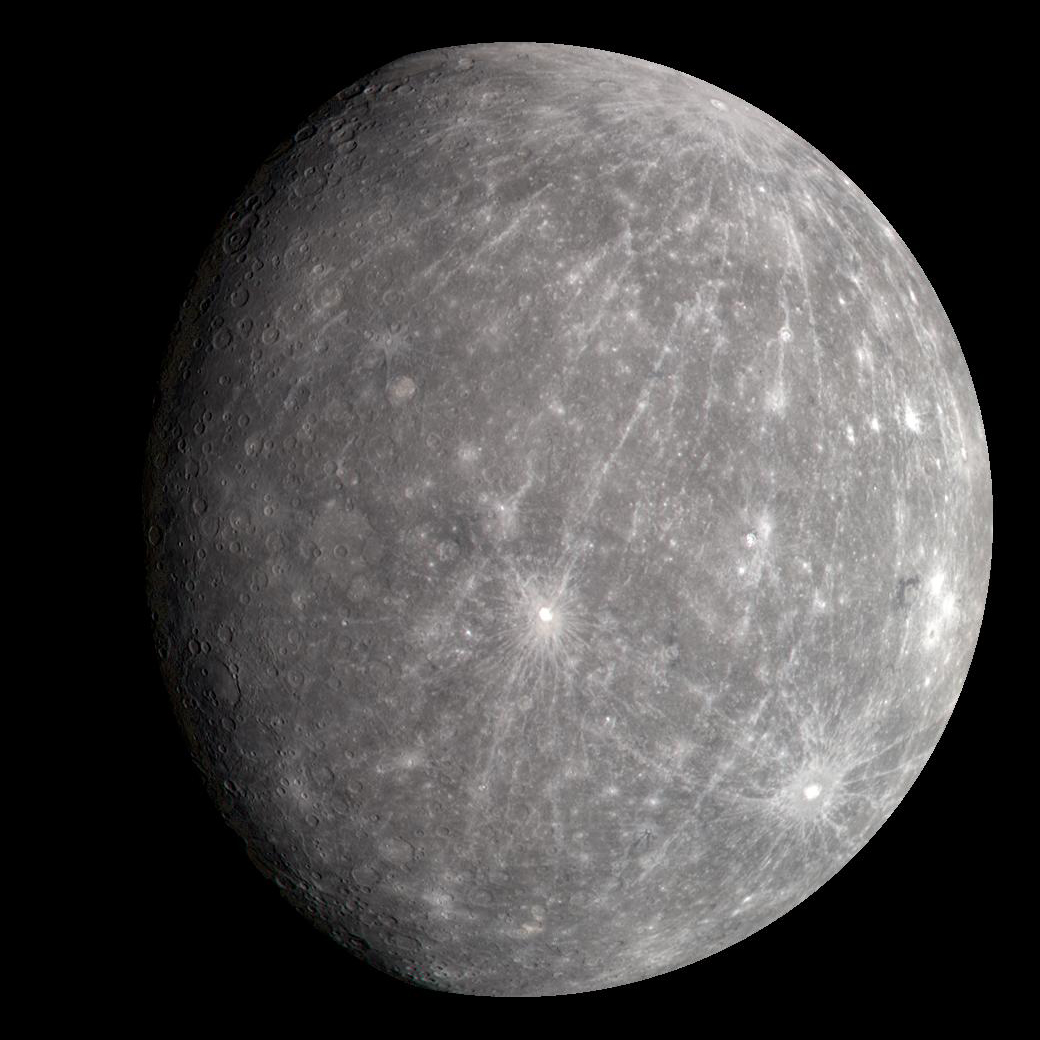
Mercury, the first planet from the Sun, orbits at an average distance of just 0.39 AU and completes a revolution in a blistering 88 Earth days. Despite its diminutive size—only 4,880 km in diameter, about one‑third that of Earth—Mercury boasts a dense iron core that accounts for roughly 60 % of its total mass, giving it a surface gravity of 3.7 m s⁻², slightly higher than that of Mars. Its surface is a stark, airless landscape reminiscent of the Moon: heavily cratered, peppered with bright ray systems, and traversed by an extensive network of rupes (cliff‑like thrust faults) that record the planet’s early tectonic activity.The most prominent feature is Caloris Planitia, a massive impact basin 1,550 km across—about one‑third the planet’s diameter. The basin’s rim rises up to 2 km, and its floor is filled with smooth plains of volcanic origin. Surrounding Caloris are concentric rings of secondary craters and bright ejecta rays that stretch for hundreds of kilometers. Mercury’s tenuous exosphere, composed mainly of sodium, potassium, and trace amounts of helium and hydrogen, is constantly replenished by micrometeoroid impacts and solar wind sputtering, giving the planet a “trace atmosphere” that is far too thin to support weather.
Because it orbits so close to the Sun, Mercury is always seen near the solar glare, appearing either as a morning star or an evening star. Its orbital eccentricity (0.206) and 3:2 spin‑orbit resonance—three rotations for every two revolutions—produce extreme temperature swings, from a scorching 430 °C on the sun‑facing side to a frigid −180 °C on the night side.
History/Background
The ancient Greeks named the planet after the swift messenger of the gods, reflecting its rapid motion across the sky. Mercury was known to every civilization that could observe the heavens, but it remained a mystery until the space age. The first successful flyby was achieved by Mariner 10 in 1974–1975, which imaged roughly 45 % of the surface and revealed its Moon‑like terrain and magnetic field. In 2008, NASA’s MESSENGER (MErcury Surface, Space ENvironment, GEochemistry, and Ranging) entered orbit, delivering a complete global map, confirming the presence of water‑ice deposits in permanently shadowed polar craters, and refining measurements of the planet’s interior structure.Key dates:
- 1631 CE: Galileo’s telescopic observations first resolve Mercury’s phases, confirming its orbital motion around the Sun.
- 1974‑75: Mariner 10 flybys provide first close‑up images.
- 2008‑2015: MESSENGER orbital mission maps the entire planet.
- 2025 (planned): ESA‑JAXA BepiColombo mission will complete detailed studies of Mercury’s exosphere and interior.
Key Information
- Orbital period: 88 days; rotation period: 58.6 days (3:2 resonance). - Diameter: 4,880 km; mass: 3.30 × 10²³ kg (5.5 % of Earth’s). - Surface gravity: 0.38 g (≈3.7 m s⁻²). - Atmosphere: Extremely thin exosphere of Na, K, O, He, H. - Core: Large metallic iron‑nickel core, partially molten, generating a magnetic field ~1% Earth’s strength. - Temperature range: −180 °C to +430 °C. - Major geological features: Caloris Planitia, Scarps (e.g., Discovery Rupes), numerous impact craters (e.g., Beethoven, Tolstoj). - Delta‑v requirement: Highest of any interplanetary destination from Earth, making missions to Mercury the most energetically demanding.Significance
Mercury serves as a natural laboratory for studying planetary formation under extreme solar conditions. Its oversized iron core challenges models of accretion, suggesting either a giant impact that stripped away much of its silicate mantle or a unique early solar nebula chemistry. The planet’s magnetic field—the only terrestrial planet besides Earth to retain one—offers clues about dynamo processes in small bodies. Moreover, the discovery of water‑ice in permanently shadowed craters reshapes our understanding of volatile delivery to inner planets.From an exploration standpoint, Mercury’s high delta‑v budget has driven advances in spacecraft propulsion, gravity‑assist trajectories, and thermal protection systems, technologies that benefit missions to other challenging destinations. Its proximity to the Sun also makes Mercury a key reference point for heliophysics, helping scientists monitor solar wind interactions and space weather phenomena that affect Earth’s magnetosphere.