**
Overview
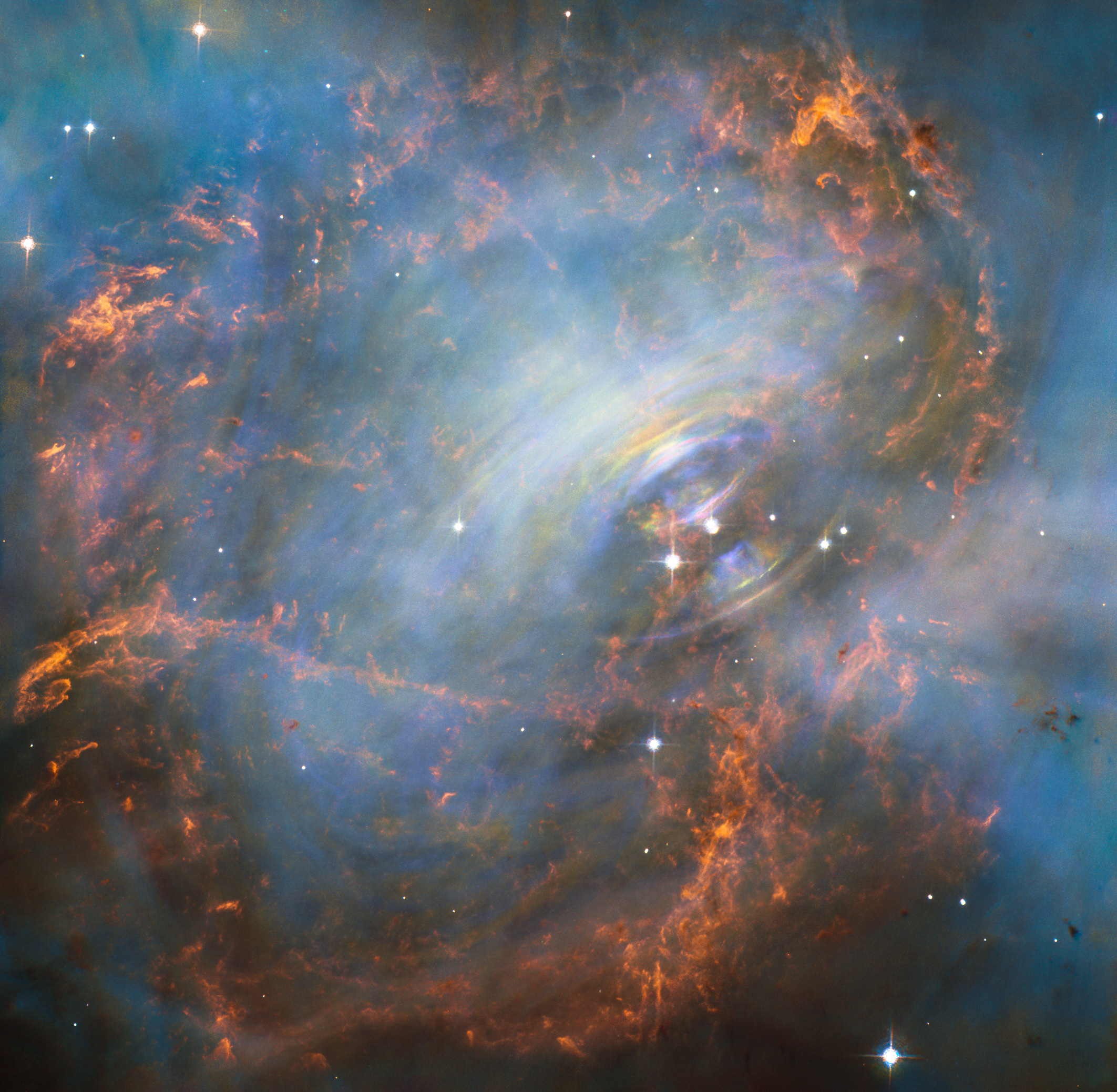
Neutron stars represent one of the most extreme states of matter known in the universe. When a massive star (typically 10–25 M☉ at birth) exhausts its nuclear fuel, its core can no longer support itself against gravity. The ensuing supernova explosion ejects the outer layers, while the inner core is crushed to densities comparable to atomic nuclei—roughly 10¹⁴ g cm⁻³. At this density, electrons and protons merge via inverse beta decay, leaving a sea of neutrons held together by the strong nuclear force and gravity. The resulting object is about the size of a city (radius ≈ 10 km) but contains a mass comparable to that of the Sun, making it the second‑most compact known stellar class after black holes.
Because of their compactness, neutron stars exhibit extraordinary physical phenomena. Their surface gravity is ~10¹¹ times Earth’s, and a teaspoon of neutron‑star material would weigh billions of tons. They also rotate incredibly fast; newly formed pulsars can spin dozens to hundreds of times per second, and some millisecond pulsars rotate over 700 times per second. Their magnetic fields are among the strongest in the cosmos, often exceeding 10¹² gauss—trillions of times stronger than Earth’s field. These extreme conditions make neutron stars natural laboratories for testing the limits of nuclear physics, general relativity, and quantum mechanics.
Neutron stars manifest observationally in several ways. The most famous are pulsars, which emit beams of radio, X‑ray, or gamma‑ray radiation that sweep across Earth like lighthouse beacons as the star spins. Some neutron stars reside in binary systems, accreting matter from a companion; the infalling gas can ignite powerful X‑ray bursts or, in rare cases, trigger a short gamma‑ray burst. The recent detection of gravitational waves from a binary neutron‑star merger (GW170817) opened a new multimessenger window, confirming that such collisions forge heavy elements like gold and platinum and produce kilonovae—short‑lived, luminous transients.
History/Background
The concept of a “collapsed star” dates back to the 1930s. In 1931, Subrahmanyan Chandrasekhar calculated the maximum mass a white dwarf could support (the Chandrasekhar limit, ~1.4 M☉). Shortly thereafter, Walter Baade and Fritz Zwicky (1934) proposed that supernovae could leave behind “neutron stars,” a term coined after the discovery of the neutron by James Chadwick in 1932. The first observational evidence arrived in 1967 when Jocelyn Bell Burnell and Antony Hewish detected regular radio pulses from CP 1919, later identified as a rotating neutron star—now known as PSR B1919+21, the first pulsar. Over the following decades, X‑ray and gamma‑ray satellites uncovered accreting neutron stars, magnetars, and thermonuclear burst sources, expanding the taxonomy of neutron‑star phenomena. The 2017 detection of GW170817 by LIGO/Virgo marked the first direct observation of a neutron‑star merger, confirming long‑standing theoretical predictions and earning the Nobel Prize in Physics in 2017.Key Information
- Mass & Size: Typical mass ≈ 1.4 M☉; radius ≈ 10–12 km; density ≈ 10¹⁴ g cm⁻³. - Composition: Primarily neutrons; a thin crust of nuclei and electrons; possible exotic phases (hyperons, deconfined quarks) in the core. - Spin: Periods range from ~1 ms to several seconds; millisecond pulsars are “recycled” by accretion in binaries. - Magnetic Field: 10⁸–10¹⁵ gauss; magnetars exhibit the highest fields and produce soft gamma‑ray repeaters and anomalous X‑ray pulsars. - Emission: Radio pulsations, X‑ray bursts, gamma‑ray flares; thermal surface emission at ~10⁶ K. - Binary Interactions: Can be part of low‑mass X‑ray binaries, high‑mass X‑ray binaries, or double‑neutron‑star systems; mergers generate gravitational waves and kilonovae. - Equation of State (EoS): Neutron‑star observations constrain the nuclear EoS, informing how matter behaves at supra‑nuclear densities. - Astrophysical Role: Sites of r‑process nucleosynthesis, contributors to Galactic chemical evolution, probes of strong‑field gravity.Significance
Neutron stars sit at the crossroads of astrophysics, nuclear physics, and fundamental relativity. Their extreme densities test theories of matter under conditions unattainable on Earth, offering clues about the behavior of neutrons, protons, and possibly exotic particles. Pulsars serve as precise cosmic clocks; arrays of millisecond pulsars are being harnessed to detect low‑frequency gravitational waves through pulsar timing arrays. Binary neutron‑star mergers have reshaped our understanding of heavy‑element production, confirming that the universe’s gold and platinum largely originate from these cataclysmic events. Moreover, the detection of gravitational waves from such mergers inaugurated multimessenger astronomy, allowing scientists to triangulate sources, measure the Hubble constant, and explore the physics of spacetime itself. In practical terms, the study of neutron‑star magnetospheres informs plasma physics and may inspire future technologies that manipulate ultra‑strong magnetic fields. Overall, neutron stars are not merely exotic curiosities; they are indispensable laboratories that illuminate the fundamental laws governing the cosmos.INFOBOX:
- Name: Neutron Star
- Type: Compact Stellar Remnant
- Date: First observed as a pulsar in 1967 (radio discovery)
- Location: Distributed throughout the Milky Way and other galaxies; often found in supernova remnants or binary systems
- Known For: Ultra‑dense matter, rapid rotation, intense magnetic fields, and as sources of gravitational waves
TAGS: neutron star, pulsar, supernova, compact object, gravitational waves, magnetar, r‑process nucleosynthesis, astrophysics