Overview
Sacred geometry represents humanity's attempt to understand the divine blueprint underlying creation through mathematical principles and geometric forms. This transcultural phenomenon perceives the universe as an intelligently designed cosmos where specific geometric proportions and shapes embody sacred meanings. Practitioners believe that by studying and replicating these patterns, one can access higher states of consciousness and connect with universal truths. From the spiral of a nautilus shell to the hexagonal cells of honeycombs, these patterns appear throughout nature, suggesting to believers an underlying cosmic order established by a divine geometer.The discipline encompasses both theoretical understanding and practical application, influencing architecture, art, meditation practices, and spiritual rituals. Sacred geometric principles manifest in mandalas, yantras, labyrinths, temple designs, and religious monuments worldwide. These patterns serve not merely as aesthetic choices but as vehicles for contemplation, meditation, and communion with the divine. By contemplating these forms, practitioners seek to align themselves with universal harmonies and access deeper levels of spiritual insight.
History/Background
The origins of sacred geometry trace back to humanity's earliest civilizations, with evidence appearing in megalithic structures like Stonehenge (c. 3000 BCE) and the Great Pyramid of Giza (c. 2560 BCE). Ancient Egyptian priests studied geometric relationships, believing they held the keys to understanding creation. The Greeks, particularly Pythagoras (c. 570-495 BCE), elevated geometry to sacred status, with his famous declaration "All is number" reflecting the belief that mathematical relationships form the foundation of reality.Medieval cathedral builders applied sacred geometric principles extensively, with master masons using specific proportions like the golden ratio (approximately 1:1.618) and root rectangles to create spaces designed to elevate the soul. Islamic geometric patterns, forbidden from depicting living forms, reached extraordinary sophistication in places like the Alhambra, where intricate tessellations reflect infinite divine creation. During the Renaissance, artists and architects like Leonardo da Vinci incorporated these principles, seeing in geometric proportions the harmony of the human body reflecting cosmic order.
Key Information
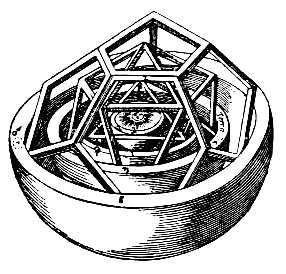
Fundamental sacred geometric forms include the circle (unity and perfection), the square (material reality), and the triangle (divine manifestation). The Flower of Life, composed of nineteen overlapping circles, appears in ancient sites worldwide and contains within it all geometric forms. The Golden Spiral, derived from the golden rectangle, manifests in galaxies, hurricanes, and sunflower seed arrangements. Metatron's Cube contains all five Platonic solids, which medieval scholars associated with the classical elements.The Vesica Piscis, formed by two intersecting circles, generates the square roots of 2, 3, and 5, fundamental to many sacred structures. These proportions appear in the Parthenon, Notre-Dame Cathedral, and the Kaaba in Mecca. Modern applications extend beyond religious contexts, influencing contemporary architecture like the Sydney Opera House and appearing in new age spirituality, healing practices, and environmental design seeking to create harmonious spaces.
Significance
Sacred geometry's enduring relevance lies in its capacity to reveal connections between seemingly disparate phenomena, suggesting an underlying unity in creation. By studying these patterns, practitioners develop what ancient wisdom traditions term "sacred sight" - the ability to perceive divine order in apparent chaos. This perspective has influenced environmental movements, inspiring biomimetic design that learns from nature's efficient patterns.The practice continues evolving, with quantum physics discoveries about the geometric nature of subatomic particles lending scientific credibility to ancient intuitions. Whether viewed as divine revelation or psychological archetypes, sacred geometric patterns provide powerful tools for meditation, healing, and creating spaces that nurture human consciousness. In an increasingly secular world, these forms offer a universal language transcending cultural boundaries, reminding humanity of our connection to cosmic patterns that have fascinated minds across millennia.