




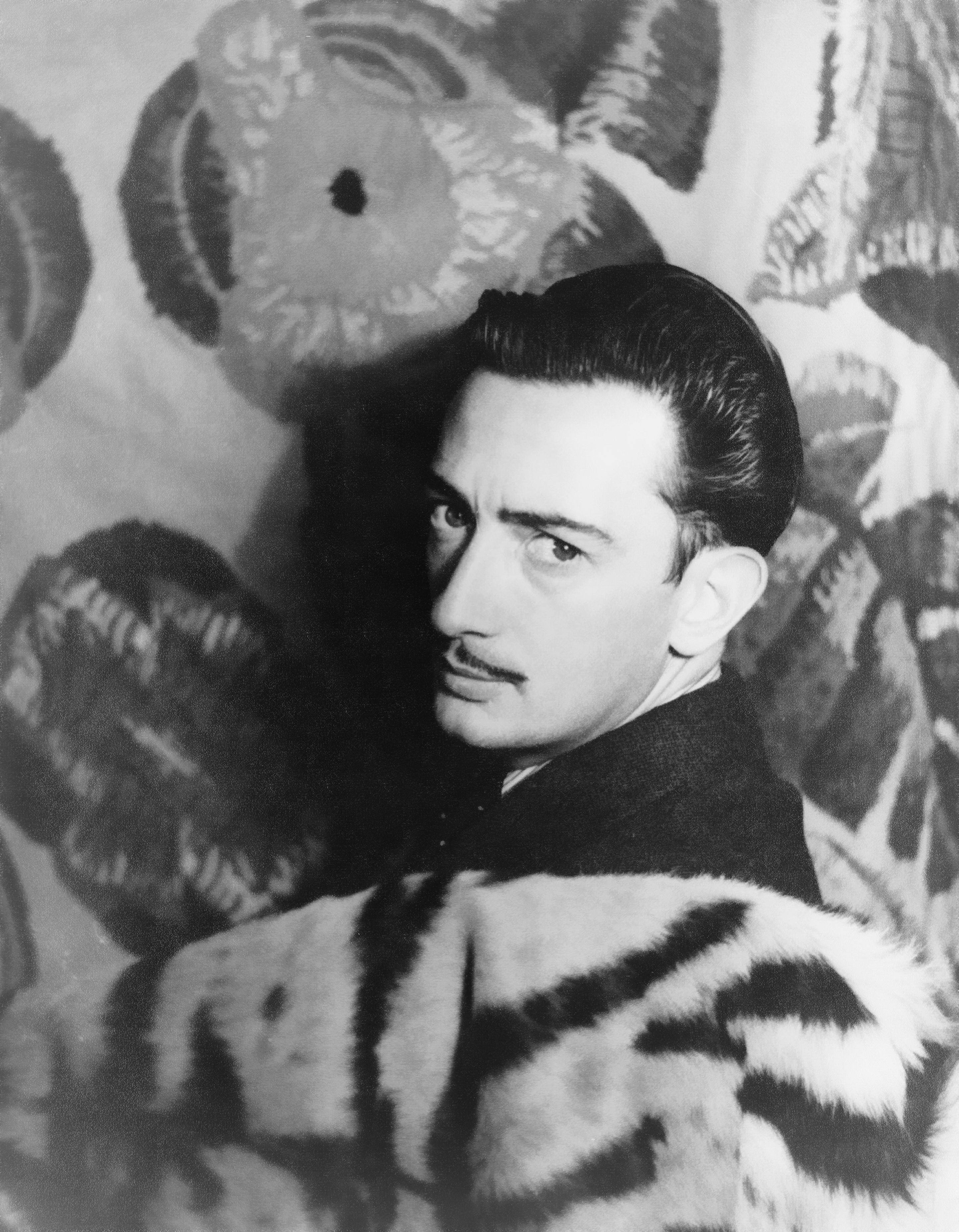
Salvador Dalí
Salvador Dalí was a Spanish surrealist artist renowned for his technical skill, precise draftsmanship, and the striking and bizarre images in his work. Throughout his long and prolific career, Dalí explored various mediums, including painting, sculpture, photography, and film, leaving an indelible mark on the world of art. His innovative and often provocative style, which blended the rational and the irrational, has captivated audiences for generations, cementing his status as one of the most iconic and influential artists of the 20th century.
Born in Figueres, Catalonia, Spain, in 1904, Dalí was the son of a lawyer and a housewife. His early life was marked by a deep interest in art, which was encouraged by his parents. Dalí's father, Salvador Dalí i Cusí, was a strict disciplinarian who pushed his son to excel academically, while his mother, Felipa Domènech Ferrés, was a more nurturing influence who fostered Dalí's creative inclinations. Dalí's early artistic training was formal, with studies at the San Fernando Academy of Fine Arts in Madrid, where he was exposed to a wide range of artistic styles and techniques.
Dalí's artistic development was also influenced by his relationship with the artist and writer, Federico García Lorca, who became a close friend and mentor. Lorca's poetry and plays had a profound impact on Dalí's work, introducing him to the world of surrealist literature and encouraging him to explore the realm of the irrational and the subconscious. In 1929, Dalí met the French artist, Pablo Picasso, who became a lifelong friend and rival. The two artists engaged in a series of public debates and exhibitions, which helped to establish Dalí as a major figure in the surrealist movement.
Early Life and Education
Salvador Dalí was born on May 11, 1904, in Figueres, Catalonia, Spain, to Salvador Dalí i Cusí and Felipa Domènech Ferrés. His father was a lawyer who served as a mayor of Figueres, while his mother was a housewife who managed the family's estate. Dalí's early life was marked by a deep interest in art, which was encouraged by his parents. He began drawing and painting at an early age, and his talent was soon recognized by his teachers.
Dalí's early artistic training was formal, with studies at the San Fernando Academy of Fine Arts in Madrid. He was exposed to a wide range of artistic styles and techniques, including traditional realism, impressionism, and cubism. Dalí's time at the academy was marked by a series of struggles, including a dispute with his teacher, Joaquín Torres García, who criticized Dalí's work as being too focused on technique. Despite these challenges, Dalí persevered, and his artistic skills continued to develop.
Career
Dalí's artistic career spanned over six decades, during which he produced a wide range of works, including paintings, sculptures, photographs, and films. His early work was influenced by the cubist movement, but he soon developed his own unique style, which blended the rational and the irrational. Dalí's use of symbolism, dream imagery, and other surrealist techniques helped to establish him as a leading figure in the surrealist movement.
In the 1930s, Dalí's work became increasingly popular, and he began to receive international recognition. He was invited to participate in a series of exhibitions, including the 1936 Exposition Internationale du Surréalisme in Paris, which helped to establish him as a major figure in the surrealist movement. Dalí's work was also featured in a series of publications, including the journal La Révolution Surréaliste, which helped to spread his ideas and influence a wider audience.
Legacy
Dalí's legacy is complex and multifaceted, reflecting the contradictions and paradoxes of his own personality and work. On the one hand, he was a brilliant artist who pushed the boundaries of what was possible in the visual arts. His innovative use of symbolism, dream imagery, and other surrealist techniques helped to establish him as a leading figure in the surrealist movement, and his work continues to inspire artists and designers around the world.
On the other hand, Dalí's personal life was marked by controversy and scandal. He was known for his flamboyant and eccentric personality, which often led to public feuds and disputes with other artists and intellectuals. Dalí's relationships with women were also marked by controversy, including his marriage to the actress, Eva Duarte, who was 20 years his junior.
Criticism and Controversy
Dalí's work has been the subject of intense criticism and controversy over the years. Some critics have accused him of being a charlatan or a showman, who used his artistic talent to manipulate and deceive his audience. Others have criticized his use of symbolism and other surrealist techniques, which they see as obscure or pretentious.
Despite these criticisms, Dalí's work continues to be widely admired and studied. His innovative use of symbolism, dream imagery, and other surrealist techniques has helped to establish him as a leading figure in the surrealist movement, and his work continues to inspire artists and designers around the world.







