Overview
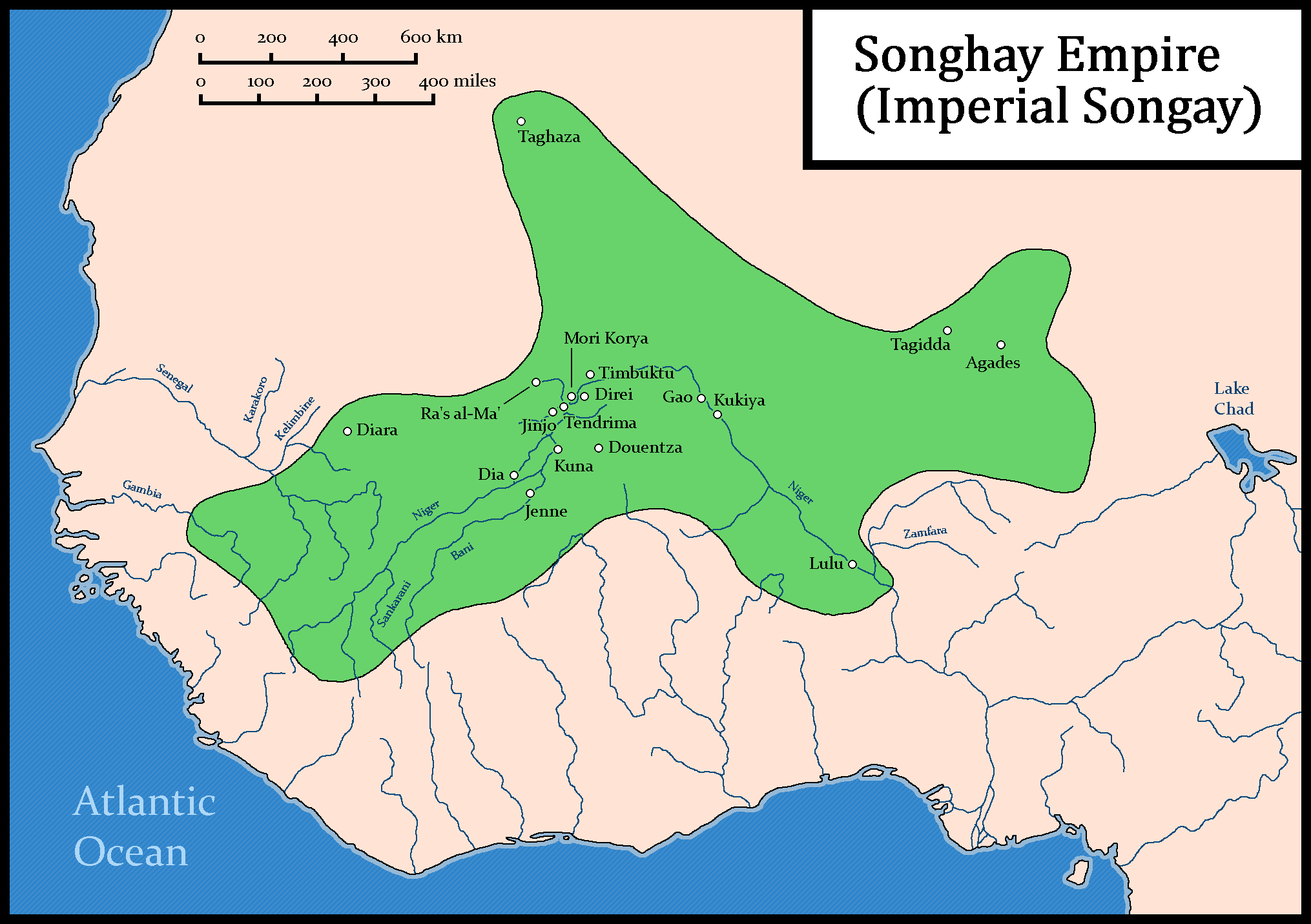
Between the Sahara’s southern fringe and the Niger River’s great bend rose a polity so vast that contemporaries claimed the sun never set on its borders. The Songhai Empire, dominated by the Songhai-speaking people of the middle Niger, absorbed the older realms of Ghana and Mali and forged a centralized state whose wealth sprang from gold, salt, and the taxes that caravans paid at its desert ports. At its 16th-century height it encompassed c. 1.4 million km²—larger than any contemporary European state—and commanded an army of cavalry, river-fleet, and infantry regiments that could field 40,000 men. Urban life flourished in Timbuktu, Djenné, and Gao, where merchants, clerics, and scholars conversed in Arabic, Soninke, and Songhai, producing books, maps, and legal opinions that circulated from Cairo to Granada.History/Background
Songhai-speaking farmers and fishermen had organized small chiefdoms along the Niger since late antiquity, but external trade—especially Saharan salt for Bambuk gold—accelerated social complexity. By the early 11th century the kingdom of Gao (Arabic: Kawkaw) was minting its own currency and sending kings on the hajj. Mali’s rise in the 13th century reduced Gao to vassalage, yet when Mali’s grip slackened after 1400, local ruler Sonni Ali (r. 1464-1492) unleashed a program of conquest. Using an amphibious army that moved in flat-bottomed cargo boats (sort of a medieval marine corps), he swallowed Timbuktu (1468) and Djenné (1475), then pushed north to the salt mines of Taghaza and south into the Hausa states. His successor, Muhammad Touré (1493-1528), overthrew the Sonni dynasty, took the title Askia (“usurper-commander”), and created the Askia dynasty. Askia Muhammad institutionalized Islamic courts, divided the realm into provinces run by royal appointees, and opened the famed Sankoré university in Timbuktu. After 1528 dynastic fratricide and Moroccan pressure eroded central authority; in 1591 a 4,000-man Moroccan force armed with matchlocks crushed Songhai’s army at Tondibi, and the empire fragmented into successor kingdoms such as the Dendi and the Bamana states of Ségou.Key Information
- Capital: Gao (population c. 70,000), whose royal palace, the “Soriya,” was a walled citadel of fired-brick and towered over the Niger.
- Economy: Trans-Saharan caravans exported an estimated 25,000–30,000 oz of gold annually; Songhai levied a 10% ad valorem toll on all goods. Salt slabs from Taghaza were literally worth their weight in gold in the forest zones.
- Administration: The Askia appointed two chief ministers—the Kurmina-fari (viceroy of the west) and the Dendi-fari (viceroy of the east)—while provincial governors supplied fixed quotas of troops and grain.
- Military: Core units included the royal cavalry (sofa) equipped with quilted armor and iron helmets, riverine flotillas of 400-ton pirogues armed with bowmen, and a standing militia of slave-soldiers (c. 9,000) loyal only to the Askia.
- Scholarship: Timbuktu housed c. 150-180 Qur’anic schools; the 16th-century chronicle Tarikh al-Sudan lists 26 active professors at Sankoré, whose libraries survive in 700,000+ manuscripts now being digitized.
- Currency: Gold dust measured in mitkal (4.5 g) and large copper bars (tasū) minted in Djenné; cowries imported from the Maldives served as small change.
- Religion: Islam was the state cult, but Askia rulers consulted traditional soothsayers (somono) and maintained sacred groves along the Niger.Significance
Songhai’s collapse in 1591 marked the end of indigenous imperial experiments in the Sahel and opened an era of trans-Atlantic trade that shifted economic gravity toward the coast. Yet the empire’s legacy persists: its administrative model—professional bureaucracy, provincial governors, and tax farming—prefigured later West African states; its scholarly corpus underpins contemporary efforts to reclaim Africa’s intellectual history; and its epic, the “Era of Askias,” remains a charter myth for modern Mali and Niger. Archaeologists now use LIDAR to map the 4-km² urban grid of 16th-century Gao, while Malian musicians sample Askia-era poems in desert blues. In global perspective, Songhai demonstrates that early-modern state formation, literacy, and market integration were not European monopolies but shared Afro-Eurasian achievements.
Tip: double-click any word in this article for an instant definition from the NerdDictionary.