




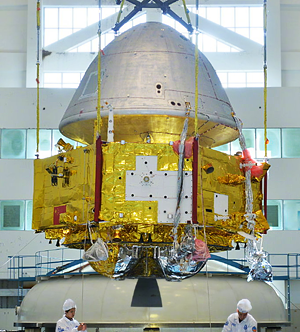
Overview
Tianwen‑1 (Chinese for “Heavenly Questions‑1”) represents a bold step in China’s planetary‑exploration roadmap. Launched on 23 July 2020 aboard a Long March 5 heavy‑lift rocket, the mission carried a single integrated spacecraft that later separated into six functional elements: an orbiter, two deployable cameras, a lander, a remote surface camera, and the Zhurong rover. With a launch mass approaching five metric tons, it ranks among the heaviest probes ever sent to Mars, allowing a generous payload of 14 scientific instruments to study the planet’s atmosphere, surface composition, and subsurface structure.The mission architecture was deliberately compact yet versatile. After a 7‑month cruise, the orbiter entered Martian orbit on 10 February 2021, commencing a year‑long mapping campaign. The lander‑rover complex detached on 14 May 2021, executing a powered descent that placed the lander on Utopia Planitia, where the Zhurong rover unfurled its wheels and began a 90‑sol (Martian day) primary science campaign. The integrated design, which allowed simultaneous orbital and surface operations, demonstrated China’s growing mastery of deep‑space navigation, entry‑descent‑landing (EDL) technology, and autonomous rover operations.
History/Background
The seeds of Tianwen‑1 were sown in the early 2010s when CNSA launched its Planetary Exploration of China program, a multi‑mission roadmap that envisions progressive steps from lunar exploration to the outer planets. In 2016, CNSA approved the Mars mission concept, assigning the China Academy of Space Technology (CAST) and the Shanghai Academy of Spaceflight Technology (SAST) to lead development. The mission’s name pays homage to the ancient Chinese classic Tianwen (“Heavenly Questions”), reflecting a cultural ambition to answer fundamental questions about the cosmos.Key milestones included the successful static‑fire test of the Long March 5 in 2019, the final integration of the spacecraft at the Wenchang Satellite Launch Center, and a series of deep‑space navigation rehearsals that refined the interplanetary trajectory. The launch on 23 July 2020 marked the first time a Chinese vehicle carried a payload of this scale beyond Earth orbit. After a 7‑month cruise, the spacecraft performed a series of orbital insertion burns, culminating in a 400 km circular orbit that set the stage for the historic landing.
Key Information
- Mission name: Tianwen‑1 (Heavenly Questions‑1) - Operator: China National Space Administration (CNSA) - Launch vehicle: Long March 5 Y‑5 (5‑ton class) - Launch date: 23 July 2020 (UTC) - Mars orbit insertion: 10 February 2021 - Landing site: Utopia Planitia, 25.1° N, 109.9° E - Surface operations: Commenced 14 May 2021; primary mission planned for 90 sols (extended thereafter) - Spacecraft mass: ~4.9 t at launch; orbiter ~2.2 t, lander + rover ~2.7 t - Scientific payload: 14 instruments, including a multispectral camera, a ground‑penetrating radar, a magnetic field detector, a meteorological suite, and a laser-induced breakdown spectroscopy (LIBS) analyzer on Zhurong. - Firsts: First Chinese mission to achieve independent Mars orbit, soft landing, and rover deployment; first mission to conduct simultaneous orbital and surface science with a single launch.Significance
Tianwen‑1 reshapes the geopolitical landscape of planetary science by establishing China as a peer to NASA, ESA, and Roscosmos in Mars exploration. Technologically, the mission validated critical capabilities: high‑precision interplanetary navigation, autonomous EDL sequences, and long‑duration rover autonomy on a foreign world. Scientifically, the orbiter’s global mapping and the rover’s in‑situ analyses are enriching our understanding of Martian geology, climate history, and potential habitability, complementing data from earlier missions such as NASA’s Curiosity and Perseverance.Strategically, the success fuels the next phases of the Planetary Exploration of China program, which envisions a Mars sample‑return mission, a lunar south‑pole base, and eventual crewed missions to Mars. The public enthusiasm generated by the mission—highlighted by live broadcasts of the landing and rover deployment—has also inspired a new generation of Chinese engineers and scientists, reinforcing the nation’s long‑term commitment to deep‑space exploration.


