Overview
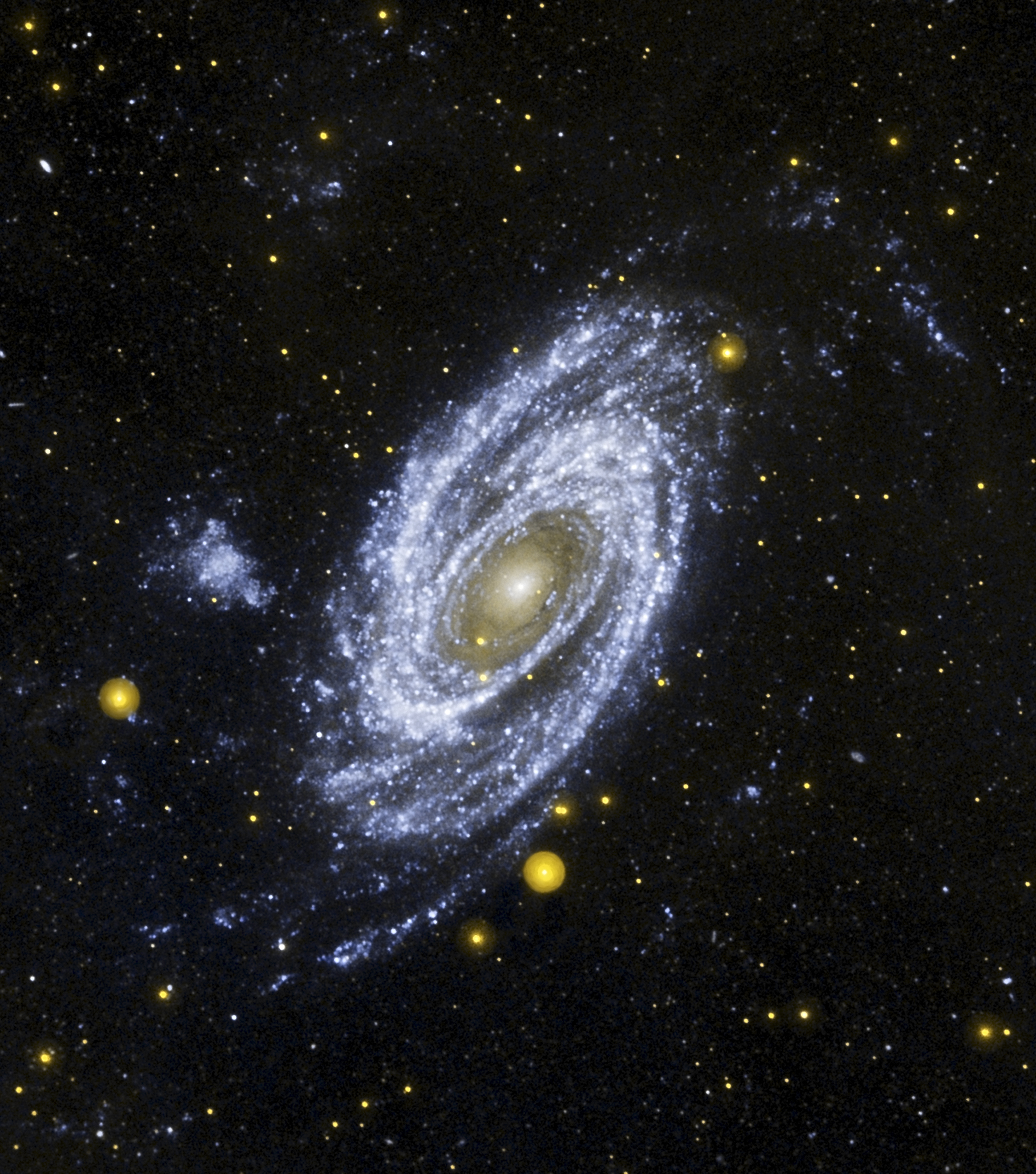
Ultraviolet astronomy is a branch of astronomy that involves the observation of electromagnetic radiation at ultraviolet wavelengths, which range from approximately 10 to 320 nanometres. This range of wavelengths is not visible to the human eye, and most of the light at these wavelengths is absorbed by the Earth's atmosphere, making it necessary to perform observations from the upper atmosphere or from space. The study of ultraviolet radiation has become a crucial tool for understanding various astrophysical phenomena, including the formation and evolution of stars, galaxies, and planetary systems.
The ultraviolet range of the electromagnetic spectrum is divided into several sub-bands, including the near-ultraviolet (NUV), far-ultraviolet (FUV), and extreme-ultraviolet (EUV). Each of these sub-bands provides unique insights into the physical processes that occur in different astrophysical environments. For example, the NUV range is useful for studying the properties of stars and galaxies, while the FUV and EUV ranges are more suited for investigating the interstellar medium and the formation of planetary atmospheres.
The development of ultraviolet astronomy has been driven by advances in technology, particularly the launch of space-based telescopes and instruments. These missions have enabled astronomers to observe the universe in unprecedented detail, revealing new and exciting phenomena that were previously unknown. Some of the key discoveries made using ultraviolet astronomy include the detection of ultraviolet excess in certain stars, which is indicative of high-temperature plasma, and the observation of ultraviolet emission lines from galaxies, which provide valuable information about their chemical composition and physical properties.
History/Background
The history of ultraviolet astronomy dates back to the early 20th century, when scientists first began to explore the ultraviolet range of the electromagnetic spectrum. However, it wasn't until the 1960s, with the launch of the first space-based telescopes, that ultraviolet astronomy began to emerge as a distinct field of research. One of the key milestones in the development of ultraviolet astronomy was the launch of the
Orbiting Astronomical Observatory (OAO) in 1966, which was the first space-based telescope designed specifically for ultraviolet observations. Since then, numerous other missions have been launched, including the
International Ultraviolet Explorer (IUE), the
Hubble Space Telescope, and the
Galaxy Evolution Explorer (GALEX).
Key Information
Some of the most important facts about ultraviolet astronomy include the range of wavelengths that are studied, which spans from approximately 10 to 320 nanometres. The
atmospheric absorption of ultraviolet radiation is a significant challenge for astronomers, as it limits the ability to observe the universe from the ground. As a result, space-based telescopes and instruments are essential for ultraviolet astronomy. The
ultraviolet spectrum is also characterized by a range of emission and absorption lines, which provide valuable information about the physical properties of astrophysical objects.
Significance
The significance of ultraviolet astronomy lies in its ability to provide unique insights into the physical processes that occur in different astrophysical environments. By studying the ultraviolet radiation emitted by stars, galaxies, and other objects, astronomers can gain a better understanding of their composition, temperature, and evolution. Ultraviolet astronomy has also played a crucial role in the discovery of new and exciting phenomena, such as
ultraviolet-bright stars and
ultraviolet-luminous galaxies. Furthermore, the study of ultraviolet radiation has important implications for our understanding of the formation and evolution of planetary atmospheres, which is essential for the search for life beyond Earth.