**
Overview
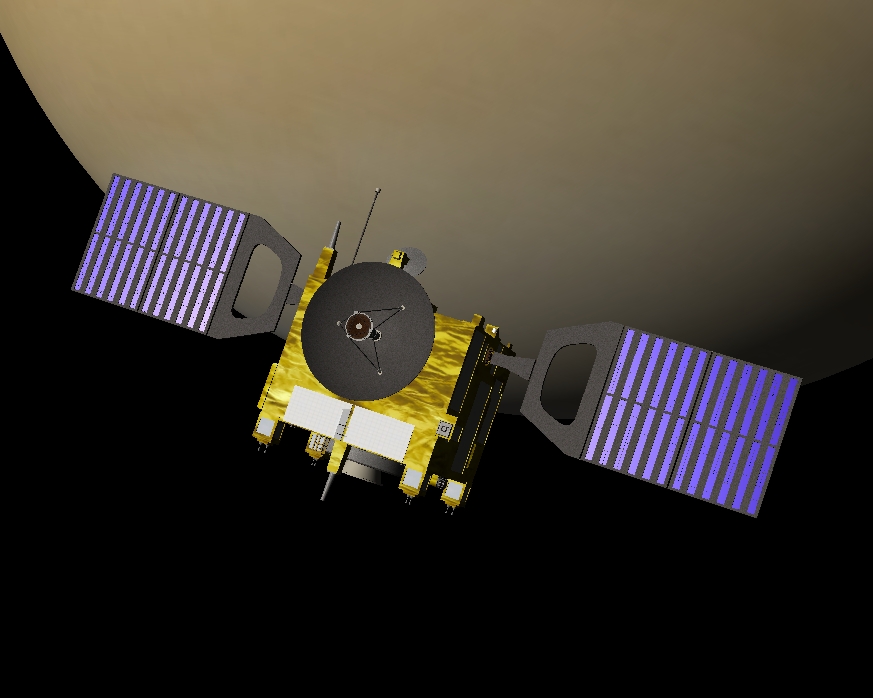
Venus Express (VEX) marked a watershed moment for European planetary science, becoming the first ESA spacecraft to orbit Venus and the first mission ever to conduct continuous, multi‑year monitoring of the planet’s hostile environment. Launched on 15 November 2005 aboard a Soyuz‑Fregat rocket from Baikonur, the probe entered a highly elliptical, near‑polar orbit on 11 April 2006. From this perch, VEX’s suite of seven scientific instruments surveyed the thick carbon‑dioxide atmosphere, the enigmatic super‑rotating winds, and the planet’s elusive surface through radar and infrared windows. By maintaining a stable orbit for more than eight Earth years, the mission captured seasonal and diurnal variations that previous fly‑by and short‑duration orbiter missions could not resolve.The spacecraft’s design emphasized longevity and thermal resilience. Its solar panels, angled to maximize power despite Venus’s proximity to the Sun, supplied roughly 1 kW of electricity, while a robust thermal control system kept the electronics within operational limits amid the planet’s intense infrared radiation. The mission’s primary scientific goal—long‑term atmospheric dynamics—was achieved through continuous measurements of temperature, cloud composition, wind speeds, and ultraviolet airglow, providing a data set that still underpins contemporary Venus research.
History/Background
The concept of a dedicated Venus orbiter emerged in the late 1990s as ESA sought a flagship planetary mission that could complement NASA’s Mars Exploration Program. After a competitive selection process, the Venus Express proposal won the 2001 ESA Science Programme’s “Medium Class” (M‑Class) slot, receiving a budget of roughly €150 million. Development was led by the European Space Research and Technology Centre (ESTEC) in the Netherlands, with instrument contributions from institutions across Europe, including the German Aerospace Center (DLR), the French National Centre for Space Studies (CNES), and the Italian Space Agency (ASI).Key milestones included the successful integration of the spacecraft bus in 2004, the launch on a Soyuz‑Fregat from Baikonur on 15 November 2005, and the critical Venus Orbit Insertion (VOI) maneuver on 11 April 2006, which placed VEX into a 250 km × 66 000 km polar orbit. Throughout its operational life, the mission underwent several orbit adjustments to lower periapsis for higher‑resolution observations, especially during the 2007 and 2009 campaigns focused on the southern polar vortex. After nine years of data return, ESA announced the mission’s planned termination; VEX was deliberately de‑orbited, burning up in Venus’s upper atmosphere on 11 December 2014.
Key Information
- Spacecraft mass: 1 260 kg (including fuel) - Power: ~1 kW from solar arrays - Orbit: Polar, 250 km periapsis, 66 000 km apoapsis, 24‑hour period - Mission duration: 8 years of science operations (2006‑2014) - Scientific payload (7 instruments): 1. VIRTIS (Visible and Infrared Thermal Imaging Spectrometer) – mapped cloud composition and surface emissivity. 2. SPICAV/SOIR (Spectroscopy for Investigation of Characteristics of the Atmosphere of Venus / Solar Occultation at Infrared) – measured atmospheric gases via solar occultation. 3. MAG (Magnetometer) – characterized Venus’s induced magnetosphere. 4. ASPERA‑4 (Analyzer of Space Plasma and Energetic Atoms) – studied plasma environment and ion escape. 5. PFS (Planetary Fourier Spectrometer) – provided high‑resolution infrared spectra of atmospheric temperature and composition. 6. VeRa (Venus Radio Science) – performed radio occultation to retrieve vertical profiles of temperature, pressure, and electron density. 7. MARSIS‑like radar (not a separate instrument but part of VeRa) – probed surface topography through the dense cloud cover.Major achievements include the discovery of variable sulfuric acid cloud layers, the detection of hydrogen cyanide (HCN) suggesting possible volcanic outgassing, and the first global maps of wind speeds at the cloud tops using ultraviolet imaging. VEX also revealed that the super‑rotation of Venus’s atmosphere is more variable than previously thought, with wind speeds fluctuating by up to 10 % over weeks. The mission’s plasma measurements clarified how solar wind interacts with Venus’s weak intrinsic magnetic field, leading to a better understanding of atmospheric escape processes.
Significance
Venus Express fundamentally reshaped our view of Earth’s sister planet. By delivering continuous, high‑resolution datasets, it enabled scientists to test and refine global circulation models, bridging the gap between short‑term spacecraft snapshots and Earth‑based telescopic observations. The mission’s findings on cloud chemistry, thermal tides, and ionospheric dynamics have direct implications for comparative planetology, especially in the context of exoplanet atmospheres that may resemble Venusian conditions.The mission also served as a technological testbed for future ESA planetary endeavors. Lessons learned in thermal management, long‑duration orbital operations, and collaborative instrument development informed the design of later missions such as BepiColombo (Mercury) and the upcoming EnVision mission to Venus, slated for launch in the 2030s. Moreover, VEX’s open data policy, with more than 30 TB of calibrated measurements freely available, has fostered a vibrant international research community, spawning dozens of Ph.D. theses and countless peer‑reviewed papers.
In a broader cultural sense, Venus Express rekindled public fascination with the “morning star,” providing stunning visualizations of the planet’s swirling clouds and dramatic sunsets that have been featured in science documentaries and museum exhibits worldwide. Its legacy endures not only in scientific literature but also in the renewed enthusiasm for exploring Venus—a planet that, despite its harshness, holds clues to planetary evolution, climate runaway, and the delicate balance that makes Earth habitable.
INFOBOX:
- Name: Venus Express
- Type: Orbital planetary science mission
- Date: Launched 15 Nov 2005 – Ended 11 Dec 2014
- Location: Orbit around Venus (polar, highly elliptical)
- Known For: First long‑term, multi‑instrument study of Venus’s atmosphere and induced magnetosphere
TAGS: Venus, ESA, planetary science, atmospheric dynamics, space exploration, orbital mission, VEX, comparative planetology