Overview
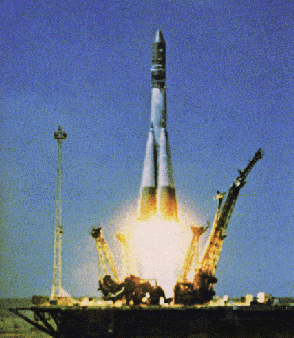
The Vostok 1 mission represented a watershed moment in human history, proving that a person could survive the rigors of orbital flight and return safely to Earth. Launched from the Baikonur Cosmodrome in Kazakhstan aboard a Vostok‑3KA spacecraft, the flight carried Yuri Gagarin, a 27‑year‑old test pilot, into a 108‑minute journey that completed a single orbit around the planet. The mission demonstrated the Soviet Union’s mastery of rocket technology, life‑support systems, and re‑entry engineering, catapulting the nation to the forefront of the nascent Space Race.The flight profile was deliberately simple yet daring: after a launch vehicle (the R‑7 Semyorka) placed the capsule into a low‑Earth orbit of roughly 327 km perigee and 339 km apogee, Gagarin’s spacecraft performed a single revolution before the descent module separated, re‑entered the atmosphere, and deployed a parachute for a soft landing. Although Gagarin ejected from the capsule at about 7 km altitude—a safety measure dictated by the technology of the time—the mission proved that humans could endure the full sequence of launch, orbit, and recovery.
Vostok 1’s success was not merely a technical triumph; it was a profound cultural and political statement. The flight was broadcast worldwide, and Gagarin’s cheerful “Poyekhali!” (“Let’s go!”) became an iconic phrase symbolizing humanity’s leap into the cosmos. The mission set the stage for subsequent Soviet achievements, including Vostok 2–6, and spurred the United States to accelerate its own crewed space program, ultimately leading to the Apollo Moon landings.
History/Background
The Vostok programme emerged from the Soviet Union’s post‑World‑II emphasis on missile development and scientific prestige. In 1955, the OKB‑1 design bureau, led by Sergei Korolev, began work on a crewed spacecraft that could survive orbital flight. The design drew on earlier missile and satellite projects, notably the R‑7 launch vehicle that had already placed Sputnik 1 into orbit in 1957. By 1960, the Vostok‑3KA capsule had undergone extensive unmanned testing, including the Korabl‑Sputnik and Vostok‑1 (uncrewed) flights, which validated life‑support, thermal control, and re‑entry systems.Selection of the first cosmonaut was a rigorous process. From a pool of over 200 candidates, Gagarin was chosen for his physical fitness, calm demeanor, and ability to quickly master complex instrumentation. The final preparations culminated on 12 April 1961, when the R‑7 Semyorka lifted off at 06:07 UTC, carrying the Vostok 1 spacecraft into space. The mission’s success was confirmed when ground stations received telemetry indicating a stable orbit, and the capsule’s descent was tracked to the Kazakh steppe, where Gagarin was recovered by a Soviet recovery team.
Key Information
- Mission name: Vostok 1 (Vostok‑3KA‑1) - Launch vehicle: R‑7 Semyorka (serial number 8K71) - Launch site: Baikonur Cosmodrome, Site 1/5 (Gagarin’s Start) - Date and time: 12 April 1961, 06:07 UTC - Orbit: Low Earth orbit, inclination ≈ 65.1°, period ≈ 89 minutes, altitude 327–339 km - Crew: 1 (Yuri Gagarin) – first human in space - Mission duration: 108 minutes (one complete orbit) - Re‑entry method: Capsule separation, atmospheric braking, parachute deployment; cosmonaut ejected at ~7 km altitude for a parachute‑assisted landing. - Primary objectives: Demonstrate human survival in orbital flight, validate spacecraft systems, and achieve a controlled re‑entry and recovery. - Achievements: First human to achieve orbital velocity (≈ 7.9 km/s), first to experience weightlessness for ~30 minutes, first to view Earth from orbit, and first to transmit a live radio broadcast from space.Significance
Vostok 1 reshaped the geopolitical landscape of the Cold War by establishing Soviet preeminence in space exploration. The mission’s success forced the United States to reevaluate its own space ambitions, directly influencing President Kennedy’s 1961 pledge to land a man on the Moon. Technologically, Vostok 1 validated critical systems—such as the environmental control, automatic orientation, and re‑entry heat shield—that became foundational for later spacecraft, including Vostok‑2, Voskhod, and Soyuz.Culturally, Yuri Gagarin became an international hero, embodying the ideal of peaceful scientific progress. His flight inspired generations of engineers, scientists, and dreamers, fostering a global fascination with space that persists today. The mission also demonstrated the feasibility of long‑duration human spaceflight, paving the way for orbital stations, lunar missions, and eventually interplanetary exploration. In the annals of human achievement, Vostok 1 stands as the first step beyond Earth’s atmosphere, a bold proof that humanity could venture beyond its home planet.