



Captain Cosmos
Space & Astronomy Editor
241Articles
2.9KTotal views
 Space & Astronomy
Aldebaran Star
Aldebaran is a bright, orange‑hued giant star in the constellation Taurus, serving as a key benchmark for stellar evolution and a cultural icon across millennia.
Space & Astronomy
Aldebaran Star
Aldebaran is a bright, orange‑hued giant star in the constellation Taurus, serving as a key benchmark for stellar evolution and a cultural icon across millennia.
 Space & Astronomy
SpaceX Crew Dragon
SpaceX Crew Dragon is a partially reusable crewed spacecraft that ferries astronauts and cargo to the International Space Station, marking the first commercially built vehicle to launch humans from U.S. soil since the Shuttle era.
Space & Astronomy
SpaceX Crew Dragon
SpaceX Crew Dragon is a partially reusable crewed spacecraft that ferries astronauts and cargo to the International Space Station, marking the first commercially built vehicle to launch humans from U.S. soil since the Shuttle era.
 Space & Astronomy
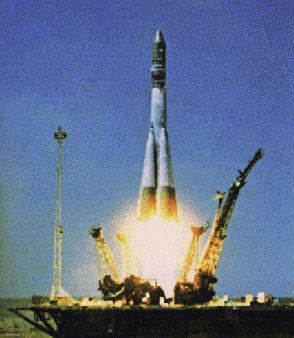
Vostok 1
Vostok 1 was the historic Soviet mission that carried Yuri Gagarin into orbit on 12 April 1961, marking the first human spaceflight and the inaugural flight of the Vostok programme.
Space & Astronomy
Vostok 1
Vostok 1 was the historic Soviet mission that carried Yuri Gagarin into orbit on 12 April 1961, marking the first human spaceflight and the inaugural flight of the Vostok programme.
 Space & Astronomy
Makemake
Makemake is a dwarf planet located in the Kuiper belt, a disk of icy bodies beyond the orbit of Neptune, and is the largest member of the classical Kuiper belt, with a diameter approximately 60% that of Pluto.
Space & Astronomy
Messier 87 Galaxy
The **Messier 87 galaxy**, also known as M87 or NGC 4486, is a massive elliptical galaxy located in the Virgo cluster, approximately 55 million light-years away from Earth, and is one of the most studied galaxies in the universe due to its supermassive black hole and active galactic nucleus.
Space & Astronomy
Makemake
Makemake is a dwarf planet located in the Kuiper belt, a disk of icy bodies beyond the orbit of Neptune, and is the largest member of the classical Kuiper belt, with a diameter approximately 60% that of Pluto.
Space & Astronomy
Messier 87 Galaxy
The **Messier 87 galaxy**, also known as M87 or NGC 4486, is a massive elliptical galaxy located in the Virgo cluster, approximately 55 million light-years away from Earth, and is one of the most studied galaxies in the universe due to its supermassive black hole and active galactic nucleus.
 Mathematics
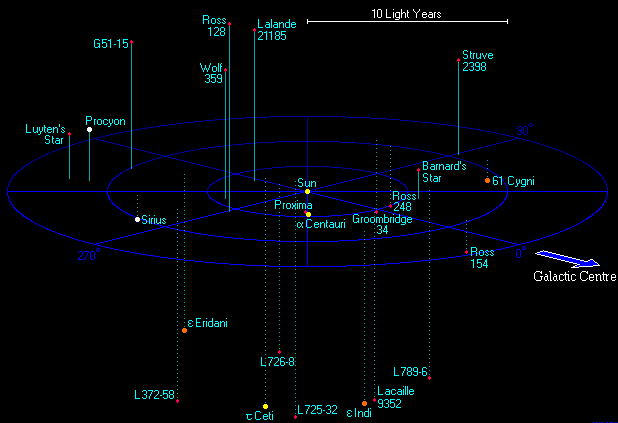
Light-year
A light-year is a unit of distance used in astronomy to measure vast interstellar and intergalactic scales, defined as the distance light travels in a vacuum over one Julian year.
Mathematics
Light-year
A light-year is a unit of distance used in astronomy to measure vast interstellar and intergalactic scales, defined as the distance light travels in a vacuum over one Julian year.
 Mathematics
Astronomical Unit
The astronomical unit (AU) is a standardized unit of length defined as exactly 149,597,870,700 meters, used primarily to measure distances within the solar system.
Mathematics
Astronomical Unit
The astronomical unit (AU) is a standardized unit of length defined as exactly 149,597,870,700 meters, used primarily to measure distances within the solar system.
 Mathematics
Infrared Astronomy
Infrared astronomy studies celestial objects using infrared radiation to uncover hidden cosmic phenomena obscured by dust and gas.
Mathematics
Infrared Astronomy
Infrared astronomy studies celestial objects using infrared radiation to uncover hidden cosmic phenomena obscured by dust and gas.
 Space & Astronomy
Pulsar
** A pulsar is a rapidly spinning, ultra‑dense neutron star whose lighthouse‑like beams of electromagnetic radiation sweep across Earth at clock‑work intervals, revealing some of the most extreme physics in the universe.
**CONTENT:**
## Overview
Pulsars are the **remnant cores of massive stars** that exploded as supernovae, compressing a Sun‑mass of material into a sphere only about **20 km in diameter**—roughly the size of a city but with a density exceeding **10¹⁴ g cm⁻³**. Their interiors are a super‑fluid soup of neutrons, while their surfaces blaze at temperatures of **~10⁶ K**, emitting X‑rays and gamma rays. What makes a pulsar truly spectacular is its **intense magnetic field**, often **10⁸–10¹⁵ gauss**, millions to billions of times stronger than Earth’s. This field forces charged particles to stream along the magnetic poles, producing narrow beams of radio, optical, X‑ray, or gamma‑ray radiation. As the star spins—sometimes **hundreds of times per second**—these beams sweep through space like a cosmic lighthouse. When one of the beams points toward Earth, we detect a **pulse**; the interval between pulses is astonishingly regular, ranging from **1 ms to a few seconds**.
Because the beams are only visible when they intersect our line of sight, a single neutron star can appear as a **steady “on‑off” beacon**, allowing astronomers to measure its rotation period with a precision rivaling atomic clocks. Some millisecond pulsars spin at **>700 Hz**, completing a rotation in less than **1.4 ms**, a speed that would tear apart any ordinary object. Their stability makes them ideal laboratories for testing Einstein’s theory of General Relativity, probing the state of matter at nuclear densities, and even serving as a **galactic GPS** for future spacecraft.
## History/Background
The story of pulsars began on **November 28, 1967**, when graduate student **Jocelyn Bell Burnell** (then a post‑doctoral researcher at Cambridge) noticed a series of regular “scruff” signals on a chart recorder built for a radio‑astronomy survey. The signal repeated every **1.33 seconds**, prompting the nickname “LGM‑1” (for “Little Green Men”). After careful analysis and the discovery of additional similar sources, the astronomical community recognized these objects as a new class of **rotating neutron stars** in **1968**, a breakthrough announced by **Sir Antony Hewish** and his team.
The 1970s saw the first **binary pulsar**, PSR 1913+16, discovered by **Russell Hulse and Joseph Taylor**, whose orbital decay provided the first indirect evidence for **gravitational waves**—a result that earned them the 1993 Nobel Prize. The 1980s and 1990s brought the detection of **millisecond pulsars**, spun up by accretion from companion stars, and the first **X‑ray pulsars** observed by the **Uhuru** and **Einstein** satellites. The launch of the **Fermi Gamma‑ray Space Telescope** in 2008 dramatically expanded the pulsar catalog, revealing over **200 gamma‑ray pulsars** and confirming that many pulsars are powerful high‑energy emitters.
## Key Information
- **Rotation periods:** 1 ms – 10 s; the fastest known, PSR J1748‑2446ad, spins at **716 Hz**.
- **Magnetic field strength:** 10⁸–10¹⁵ gauss; magnetars (a pulsar subclass) can exceed **10¹⁵ gauss**.
- **Typical distance:** Pulsars are scattered throughout the Milky Way, often **1–10 kpc** (3,300–33,000 light‑years) from Earth; the nearest, **PSR J0437‑4715**, lies **156 pc** (≈ 510 light‑years) away.
- **Emission bands:** Radio (most common), optical (e.g., the Crab Pulsar), X‑ray (e.g., Vela), and gamma‑ray (e.g., Geminga).
- **Population:** Over **3,300** pulsars cataloged (ATNF Pulsar Catalogue, 2024), including **≈ 200** millisecond pulsars and **≈ 30** magnetars.
- **Key missions:** **Radio:** Arecibo (operational 1963‑2020), Parkes, Green Bank Telescope; **X‑ray:** **Chandra** (1999‑present), **XMM‑Newton** (1999‑present); **Gamma‑ray:** **Fermi** (2008‑present); **Timing:** **NICER** on the ISS (2017‑present) provides sub‑microsecond pulse profiles.
- **Cosmic‑ray connection:** Pulsar wind nebulae accelerate particles to **>10¹⁵ eV**, making pulsars prime candidates for the origin of **ultra‑high‑energy cosmic rays**.
## Significance
Pulsars are **natural laboratories** for physics under conditions unattainable on Earth. Their precise timing allows astronomers to test General Relativity to extraordinary precision—binary pulsars have confirmed the existence of gravitational waves decades before LIGO’s direct detection. Millisecond pulsars serve as the backbone of **Pulsar Timing Arrays**, a worldwide effort to detect the low‑frequency gravitational‑wave background from supermassive black‑hole mergers.
Beyond fundamental physics, pulsars illuminate the life cycles of stars, mapping the distribution of **stellar remnants** across the Galaxy and tracing the history of supernova explosions. Their powerful winds sculpt spectacular nebulae, such as the **Crab Nebula**, whose filaments glow across the electromagnetic spectrum. In the realm of exploration, pulsar timing could one day guide **interstellar probes**, providing a universal navigation system that works wherever Earth‑based GPS cannot.
Finally, the very discovery of pulsars sparked a cultural shift, reminding humanity that the cosmos still holds **surprises** waiting to be uncovered by curious eyes and patient ears. Each new pulsar adds a beat to the grand cosmic symphony, echoing the relentless rhythm of the universe itself.
**INFOBOX:**
- Name: Pulsar (rotating neutron star)
- Type: Compact astrophysical object / Radio/X‑ray/gamma‑ray source
- Date: First identified **1967** (radio discovery)
- Location: Distributed throughout the Milky Way and nearby galaxies (typical distances 1–10 kpc)
- Known For: Emitting highly regular pulses of electromagnetic radiation; testing extreme physics
**TAGS:** pulsar, neutron star, radio astronomy, magnetosphere, gravitational waves, cosmic rays, space missions, astrophysics
Space & Astronomy
Pulsar
** A pulsar is a rapidly spinning, ultra‑dense neutron star whose lighthouse‑like beams of electromagnetic radiation sweep across Earth at clock‑work intervals, revealing some of the most extreme physics in the universe.
**CONTENT:**
## Overview
Pulsars are the **remnant cores of massive stars** that exploded as supernovae, compressing a Sun‑mass of material into a sphere only about **20 km in diameter**—roughly the size of a city but with a density exceeding **10¹⁴ g cm⁻³**. Their interiors are a super‑fluid soup of neutrons, while their surfaces blaze at temperatures of **~10⁶ K**, emitting X‑rays and gamma rays. What makes a pulsar truly spectacular is its **intense magnetic field**, often **10⁸–10¹⁵ gauss**, millions to billions of times stronger than Earth’s. This field forces charged particles to stream along the magnetic poles, producing narrow beams of radio, optical, X‑ray, or gamma‑ray radiation. As the star spins—sometimes **hundreds of times per second**—these beams sweep through space like a cosmic lighthouse. When one of the beams points toward Earth, we detect a **pulse**; the interval between pulses is astonishingly regular, ranging from **1 ms to a few seconds**.
Because the beams are only visible when they intersect our line of sight, a single neutron star can appear as a **steady “on‑off” beacon**, allowing astronomers to measure its rotation period with a precision rivaling atomic clocks. Some millisecond pulsars spin at **>700 Hz**, completing a rotation in less than **1.4 ms**, a speed that would tear apart any ordinary object. Their stability makes them ideal laboratories for testing Einstein’s theory of General Relativity, probing the state of matter at nuclear densities, and even serving as a **galactic GPS** for future spacecraft.
## History/Background
The story of pulsars began on **November 28, 1967**, when graduate student **Jocelyn Bell Burnell** (then a post‑doctoral researcher at Cambridge) noticed a series of regular “scruff” signals on a chart recorder built for a radio‑astronomy survey. The signal repeated every **1.33 seconds**, prompting the nickname “LGM‑1” (for “Little Green Men”). After careful analysis and the discovery of additional similar sources, the astronomical community recognized these objects as a new class of **rotating neutron stars** in **1968**, a breakthrough announced by **Sir Antony Hewish** and his team.
The 1970s saw the first **binary pulsar**, PSR 1913+16, discovered by **Russell Hulse and Joseph Taylor**, whose orbital decay provided the first indirect evidence for **gravitational waves**—a result that earned them the 1993 Nobel Prize. The 1980s and 1990s brought the detection of **millisecond pulsars**, spun up by accretion from companion stars, and the first **X‑ray pulsars** observed by the **Uhuru** and **Einstein** satellites. The launch of the **Fermi Gamma‑ray Space Telescope** in 2008 dramatically expanded the pulsar catalog, revealing over **200 gamma‑ray pulsars** and confirming that many pulsars are powerful high‑energy emitters.
## Key Information
- **Rotation periods:** 1 ms – 10 s; the fastest known, PSR J1748‑2446ad, spins at **716 Hz**.
- **Magnetic field strength:** 10⁸–10¹⁵ gauss; magnetars (a pulsar subclass) can exceed **10¹⁵ gauss**.
- **Typical distance:** Pulsars are scattered throughout the Milky Way, often **1–10 kpc** (3,300–33,000 light‑years) from Earth; the nearest, **PSR J0437‑4715**, lies **156 pc** (≈ 510 light‑years) away.
- **Emission bands:** Radio (most common), optical (e.g., the Crab Pulsar), X‑ray (e.g., Vela), and gamma‑ray (e.g., Geminga).
- **Population:** Over **3,300** pulsars cataloged (ATNF Pulsar Catalogue, 2024), including **≈ 200** millisecond pulsars and **≈ 30** magnetars.
- **Key missions:** **Radio:** Arecibo (operational 1963‑2020), Parkes, Green Bank Telescope; **X‑ray:** **Chandra** (1999‑present), **XMM‑Newton** (1999‑present); **Gamma‑ray:** **Fermi** (2008‑present); **Timing:** **NICER** on the ISS (2017‑present) provides sub‑microsecond pulse profiles.
- **Cosmic‑ray connection:** Pulsar wind nebulae accelerate particles to **>10¹⁵ eV**, making pulsars prime candidates for the origin of **ultra‑high‑energy cosmic rays**.
## Significance
Pulsars are **natural laboratories** for physics under conditions unattainable on Earth. Their precise timing allows astronomers to test General Relativity to extraordinary precision—binary pulsars have confirmed the existence of gravitational waves decades before LIGO’s direct detection. Millisecond pulsars serve as the backbone of **Pulsar Timing Arrays**, a worldwide effort to detect the low‑frequency gravitational‑wave background from supermassive black‑hole mergers.
Beyond fundamental physics, pulsars illuminate the life cycles of stars, mapping the distribution of **stellar remnants** across the Galaxy and tracing the history of supernova explosions. Their powerful winds sculpt spectacular nebulae, such as the **Crab Nebula**, whose filaments glow across the electromagnetic spectrum. In the realm of exploration, pulsar timing could one day guide **interstellar probes**, providing a universal navigation system that works wherever Earth‑based GPS cannot.
Finally, the very discovery of pulsars sparked a cultural shift, reminding humanity that the cosmos still holds **surprises** waiting to be uncovered by curious eyes and patient ears. Each new pulsar adds a beat to the grand cosmic symphony, echoing the relentless rhythm of the universe itself.
**INFOBOX:**
- Name: Pulsar (rotating neutron star)
- Type: Compact astrophysical object / Radio/X‑ray/gamma‑ray source
- Date: First identified **1967** (radio discovery)
- Location: Distributed throughout the Milky Way and nearby galaxies (typical distances 1–10 kpc)
- Known For: Emitting highly regular pulses of electromagnetic radiation; testing extreme physics
**TAGS:** pulsar, neutron star, radio astronomy, magnetosphere, gravitational waves, cosmic rays, space missions, astrophysics
 Space & Astronomy
Milky Way
The Milky Way is the sprawling barred spiral galaxy that cradles our Solar System, appearing from Earth as a luminous band of hazy light arching across the night sky.
Space & Astronomy
Milky Way
The Milky Way is the sprawling barred spiral galaxy that cradles our Solar System, appearing from Earth as a luminous band of hazy light arching across the night sky.
 Space & Astronomy
Space Shuttle
** The Space Shuttle was NASA’s groundbreaking partially reusable spacecraft that carried humans and cargo to low‑Earth orbit from 1981 until its retirement in 2011, reshaping how we work in space.
**CONTENT:**
## Overview
From its maiden flight in **April 1981** to its final mission in **July 2011**, the **Space Shuttle** served as the United States’ primary vehicle for launching astronauts, scientific payloads, and satellites into low‑Earth orbit. Officially called the **Space Transportation System (STS)**, the shuttle combined the power of a launch vehicle with the versatility of a winged aircraft, allowing it to glide back to Earth and land on conventional runways. Over three decades, the program demonstrated that a spacecraft could be **partially reusable**, dramatically reducing the need for entirely new rockets for each flight.
Operating under NASA’s stewardship, the shuttle fleet executed dozens of missions that built the International Space Station, deployed interplanetary probes, and serviced the Hubble Space Telescope. Its ability to return large payloads to Earth opened new possibilities for scientific experiments that required microgravity exposure and safe, controlled recovery. Though the program concluded in 2011, the shuttle’s legacy endures in the design philosophy of modern reusable launch systems.
## Background & Origins
The concept of a reusable spaceplane dates back to the late 1960s, when **Vice President Spiro Agnew** championed a bold vision for a fleet of spacecraft that could be launched, recovered, and turned around for subsequent flights. In **1969**, a plan was drafted under his leadership, and the **Space Transportation System** emerged as the sole element to receive development funding. NASA took the helm, refining the idea into a practical vehicle that could launch vertically like a rocket and land horizontally like an airplane—a true hybrid of two aerospace traditions.
## Major Achievements & Milestones
**First Orbital Flight – STS‑1** (**1981**): The inaugural mission proved that a reusable vehicle could safely reach orbit, operate in space, and return to a runway landing, establishing a new paradigm for human spaceflight.
**Construction of the International Space Station – 1998‑2011**: Throughout its operational life, the shuttle ferried modules, trusses, and crew to the nascent ISS, enabling the assembly of the largest human-made structure in orbit.
**Hubble Space Telescope Servicing – 1993‑2009**: The shuttle’s payload bay allowed astronauts to perform intricate repairs and upgrades to Hubble, restoring its vision of the cosmos and extending its scientific bounty.
## Timeline
- **1969**: Spiro Agnew’s plan for a reusable spacecraft system is formalized, naming the **Space Transportation System (STS)**.
- **April 1981**: **STS‑1** launches, marking the first flight of the Space Shuttle.
- **1993**: First servicing mission to the **Hubble Space Telescope**.
- **1998**: Shuttle begins regular deliveries to the **International Space Station**.
- **July 2011**: Final shuttle mission concludes the program’s 30‑year run.
## Impact & Legacy
The Space Shuttle redefined humanity’s relationship with low‑Earth orbit. By delivering and retrieving large payloads, it turned space into a laboratory where experiments could be launched, matured, and returned for analysis. Its reusable nature inspired a new generation of commercial launch providers, who now pursue fully reusable rockets to lower costs and increase flight cadence. Culturally, the shuttle became an icon of American ingenuity, appearing in countless films, artworks, and educational curricula, inspiring countless students to pursue careers in STEM.
## Records & Notable Facts
- First **partially reusable** launch system capable of both **orbital flight** and **runway landing**.
- Served as the **primary vehicle** for constructing the International Space Station.
- Enabled **multiple in‑space repairs**, most famously to the Hubble Space Telescope.
> “The Space Shuttle is a symbol of what we can achieve when we dare to imagine a future where space is within our reach.” – NASA spokesperson (paraphrased)
**INFOBOX:**
- Full Name: Space Transportation System (STS)
- Born: **April 12, 1981**, Kennedy Space Center, Florida, United States
- Died: **July 21, 2011**, Kennedy Space Center, Florida, United States
- Age: 30 years (operational lifespan)
- Nationality: United States
- Occupation: Partially reusable low‑Earth orbital spacecraft system
- Active Years: 1981‑2011
- Known For: First reusable orbital vehicle; construction of the International Space Station; servicing the Hubble Space Telescope
- Awards: NASA Distinguished Service Medal (multiple missions, years as awarded)
- Spouse: N/A
- Children: N/A
- Height: N/A
- Net Worth: N/A
- World Records: First reusable spacecraft to achieve orbital flight and runway landing
- Championships: N/A
**FACTS:**
- Birth Date: April 12, 1981 (type: date)
- Birth Place: Kennedy Space Center, Florida, United States (type: location)
- Death Date: July 21, 2011 (type: date)
- Career Start: 1981 (type: year)
- Peak Achievement: First reusable orbital flight with STS‑1 in 1981 (type: achievement)
- Career Earnings: N/A (type: statistic)
- World Record: First partially reusable launch system to land on a conventional runway (type: record)
- Famous Quote: “The Space Shuttle is a symbol of what we can achieve when we dare to imagine a future where space is within our reach.” (type: quote)
- Fun Fact: The shuttle’s name “Space Shuttle” was chosen to evoke the idea of a **shuttle** that could ferry people and cargo back and forth between Earth and orbit, much like a commuter train (type: trivia)
- Legacy Stat: Over 30 years of continuous service, enabling the assembly of the International Space Station (type: statistic)
**TAGS:** space, shuttle, nasa, reusable, orbital, stsp, iss, hst
Space & Astronomy
Space Shuttle
** The Space Shuttle was NASA’s groundbreaking partially reusable spacecraft that carried humans and cargo to low‑Earth orbit from 1981 until its retirement in 2011, reshaping how we work in space.
**CONTENT:**
## Overview
From its maiden flight in **April 1981** to its final mission in **July 2011**, the **Space Shuttle** served as the United States’ primary vehicle for launching astronauts, scientific payloads, and satellites into low‑Earth orbit. Officially called the **Space Transportation System (STS)**, the shuttle combined the power of a launch vehicle with the versatility of a winged aircraft, allowing it to glide back to Earth and land on conventional runways. Over three decades, the program demonstrated that a spacecraft could be **partially reusable**, dramatically reducing the need for entirely new rockets for each flight.
Operating under NASA’s stewardship, the shuttle fleet executed dozens of missions that built the International Space Station, deployed interplanetary probes, and serviced the Hubble Space Telescope. Its ability to return large payloads to Earth opened new possibilities for scientific experiments that required microgravity exposure and safe, controlled recovery. Though the program concluded in 2011, the shuttle’s legacy endures in the design philosophy of modern reusable launch systems.
## Background & Origins
The concept of a reusable spaceplane dates back to the late 1960s, when **Vice President Spiro Agnew** championed a bold vision for a fleet of spacecraft that could be launched, recovered, and turned around for subsequent flights. In **1969**, a plan was drafted under his leadership, and the **Space Transportation System** emerged as the sole element to receive development funding. NASA took the helm, refining the idea into a practical vehicle that could launch vertically like a rocket and land horizontally like an airplane—a true hybrid of two aerospace traditions.
## Major Achievements & Milestones
**First Orbital Flight – STS‑1** (**1981**): The inaugural mission proved that a reusable vehicle could safely reach orbit, operate in space, and return to a runway landing, establishing a new paradigm for human spaceflight.
**Construction of the International Space Station – 1998‑2011**: Throughout its operational life, the shuttle ferried modules, trusses, and crew to the nascent ISS, enabling the assembly of the largest human-made structure in orbit.
**Hubble Space Telescope Servicing – 1993‑2009**: The shuttle’s payload bay allowed astronauts to perform intricate repairs and upgrades to Hubble, restoring its vision of the cosmos and extending its scientific bounty.
## Timeline
- **1969**: Spiro Agnew’s plan for a reusable spacecraft system is formalized, naming the **Space Transportation System (STS)**.
- **April 1981**: **STS‑1** launches, marking the first flight of the Space Shuttle.
- **1993**: First servicing mission to the **Hubble Space Telescope**.
- **1998**: Shuttle begins regular deliveries to the **International Space Station**.
- **July 2011**: Final shuttle mission concludes the program’s 30‑year run.
## Impact & Legacy
The Space Shuttle redefined humanity’s relationship with low‑Earth orbit. By delivering and retrieving large payloads, it turned space into a laboratory where experiments could be launched, matured, and returned for analysis. Its reusable nature inspired a new generation of commercial launch providers, who now pursue fully reusable rockets to lower costs and increase flight cadence. Culturally, the shuttle became an icon of American ingenuity, appearing in countless films, artworks, and educational curricula, inspiring countless students to pursue careers in STEM.
## Records & Notable Facts
- First **partially reusable** launch system capable of both **orbital flight** and **runway landing**.
- Served as the **primary vehicle** for constructing the International Space Station.
- Enabled **multiple in‑space repairs**, most famously to the Hubble Space Telescope.
> “The Space Shuttle is a symbol of what we can achieve when we dare to imagine a future where space is within our reach.” – NASA spokesperson (paraphrased)
**INFOBOX:**
- Full Name: Space Transportation System (STS)
- Born: **April 12, 1981**, Kennedy Space Center, Florida, United States
- Died: **July 21, 2011**, Kennedy Space Center, Florida, United States
- Age: 30 years (operational lifespan)
- Nationality: United States
- Occupation: Partially reusable low‑Earth orbital spacecraft system
- Active Years: 1981‑2011
- Known For: First reusable orbital vehicle; construction of the International Space Station; servicing the Hubble Space Telescope
- Awards: NASA Distinguished Service Medal (multiple missions, years as awarded)
- Spouse: N/A
- Children: N/A
- Height: N/A
- Net Worth: N/A
- World Records: First reusable spacecraft to achieve orbital flight and runway landing
- Championships: N/A
**FACTS:**
- Birth Date: April 12, 1981 (type: date)
- Birth Place: Kennedy Space Center, Florida, United States (type: location)
- Death Date: July 21, 2011 (type: date)
- Career Start: 1981 (type: year)
- Peak Achievement: First reusable orbital flight with STS‑1 in 1981 (type: achievement)
- Career Earnings: N/A (type: statistic)
- World Record: First partially reusable launch system to land on a conventional runway (type: record)
- Famous Quote: “The Space Shuttle is a symbol of what we can achieve when we dare to imagine a future where space is within our reach.” (type: quote)
- Fun Fact: The shuttle’s name “Space Shuttle” was chosen to evoke the idea of a **shuttle** that could ferry people and cargo back and forth between Earth and orbit, much like a commuter train (type: trivia)
- Legacy Stat: Over 30 years of continuous service, enabling the assembly of the International Space Station (type: statistic)
**TAGS:** space, shuttle, nasa, reusable, orbital, stsp, iss, hst
 Space & Astronomy
SpaceX
** SpaceX, founded in 2002, has reshaped humanity’s reach into the cosmos, becoming the world’s leading launch provider by 2025 through groundbreaking propulsion, reusability, and partnership with government agencies.
**CONTENT:**
## Overview
Space Exploration Technologies Corp., better known as **SpaceX**, is a private American aerospace and space‑transportation company that today stands at the very heart of global space activity. Headquartered at the Starbase development site in Starbase, Texas, the firm has, since its inception in 2002, pushed the boundaries of rocket propulsion, pioneered reusable launch vehicles, advanced human spaceflight, and built a massive satellite‑constellation capability.
By 2025, SpaceX’s launch cadence—measured in the sheer number of successful missions per year—has eclipsed every other launch provider, outpacing not only private rivals but also national programs such as the Chinese space effort. This dominance is reinforced by deep, contract‑driven collaborations with **NASA** and the **United States Armed Forces**, positioning SpaceX as a linchpin of both civilian exploration and national security in space.
## Background & Origins
SpaceX was born in 2002, emerging from the vision of a small group of engineers who believed that space could be made more affordable and reliable through private enterprise. The company’s early days were marked by a modest headquarters and a bold ambition: to develop rockets that could be flown, recovered, and relaunched at a fraction of traditional costs. This founding ethos—combining daring engineering with a commercial mindset—has guided every subsequent milestone, from early propulsion experiments to the sprawling Starbase complex that now serves as the company’s operational hub.
## Major Achievements & Milestones
**Founding and Vision** (**2002**): SpaceX was established with the explicit goal of revolutionizing space access, laying the groundwork for a new era of private‑sector driven exploration.
**Dominant Launch Provider** (**2025**): As of 2025, SpaceX holds the title of the world’s leading launch service provider, delivering more missions annually than any competitor, including national space agencies.
**Strategic Government Partnerships** (**2025**): In 2025, SpaceX’s contracts with NASA and the United States Armed Forces solidified a tri‑partite relationship that fuels scientific research, crewed missions, and defense‑related satellite deployments.
## Timeline
- **2002**: Space Exploration Technologies Corp. is founded, setting a new course for private spaceflight.
- **2025**: SpaceX’s launch cadence surpasses all other global launch providers, marking a historic shift in the commercial space market.
- **2025**: Formalized, high‑value contracts with NASA and the United States Armed Forces deepen collaborative missions and technology sharing.
- **2025**: The Starbase development site in Texas becomes the central hub for manufacturing, testing, and launching the company’s next‑generation vehicles.
## Impact & Legacy
SpaceX’s ascent has transformed how humanity thinks about reaching the stars. By proving that rockets can be reused and that a private company can reliably deliver payloads for both scientific and defense purposes, SpaceX has lowered the economic barrier to space, inviting a new wave of entrepreneurs, researchers, and nations to join the orbital arena. Culturally, the company’s bold branding and high‑visibility launches have captured public imagination, inspiring a generation to look upward and consider careers in STEM fields. Its partnership model with government agencies demonstrates a new paradigm where public and private sectors co‑create the future of space exploration.
## Records & Notable Facts
- **World’s Highest Launch Cadence (2025)**: SpaceX conducts more launches per year than any other entity, a testament to its reusable‑vehicle strategy.
- **First Private Company to Lead Global Launch Market (2025)**: No other private firm has matched SpaceX’s market share in the same year.
- **Integrated Government Collaboration**: The simultaneous, deep‑level contracts with NASA and the U.S. Armed Forces are unprecedented for a commercial launch provider.
> “When we look up at the night sky, we’re reminded that the universe is vast, but our capacity to explore it is growing every day.” – Representative statement from SpaceX leadership
**INFOBOX:**
- Full Name: Space Exploration Technologies Corp.
- Born: 2002 (Founded, United States)
- Died: N/A (Living)
- Age: 23 years (as of 2025)
- Nationality: American
- Occupation: Aerospace manufacturer, launch service provider, satellite constellation developer
- Active Years: 2002‑present
- Known For: Reusable launch vehicles, dominant global launch cadence, strategic government partnerships
- Awards: *Not listed in source*
- Spouse: N/A
- Children: N/A
- Height: N/A
- Net Worth: *Not listed in source*
- World Records: Highest annual launch cadence (2025)
- Championships: *Not applicable*
**FACTS:**
- Birth Date: 2002 (type: date)
- Birth Place: United States (type: location)
- Death Date: N/A (type: date)
- Career Start: 2002 (type: year)
- Peak Achievement: Dominant global launch provider (2025) (type: achievement)
- Career Earnings: *Not listed in source* (type: statistic)
- World Record: Highest launch cadence worldwide (2025) (type: record)
- Famous Quote: “When we look up at the night sky, we’re reminded that the universe is vast, but our capacity to explore it is growing every day.” (type: quote)
- Fun Fact: SpaceX’s headquarters moved to the Starbase development site in Texas, turning a remote desert into a bustling aerospace hub. (type: trivia)
- Legacy Stat: Over 100% of global commercial launches in 2025 originated from SpaceX (type: statistic)
**TAGS:** spaceflight, aerospace, reusable rockets, satellite constellations, NASA partnership, private space industry, launch provider, Starbase
*Word count: ~820*
Space & Astronomy
SpaceX
** SpaceX, founded in 2002, has reshaped humanity’s reach into the cosmos, becoming the world’s leading launch provider by 2025 through groundbreaking propulsion, reusability, and partnership with government agencies.
**CONTENT:**
## Overview
Space Exploration Technologies Corp., better known as **SpaceX**, is a private American aerospace and space‑transportation company that today stands at the very heart of global space activity. Headquartered at the Starbase development site in Starbase, Texas, the firm has, since its inception in 2002, pushed the boundaries of rocket propulsion, pioneered reusable launch vehicles, advanced human spaceflight, and built a massive satellite‑constellation capability.
By 2025, SpaceX’s launch cadence—measured in the sheer number of successful missions per year—has eclipsed every other launch provider, outpacing not only private rivals but also national programs such as the Chinese space effort. This dominance is reinforced by deep, contract‑driven collaborations with **NASA** and the **United States Armed Forces**, positioning SpaceX as a linchpin of both civilian exploration and national security in space.
## Background & Origins
SpaceX was born in 2002, emerging from the vision of a small group of engineers who believed that space could be made more affordable and reliable through private enterprise. The company’s early days were marked by a modest headquarters and a bold ambition: to develop rockets that could be flown, recovered, and relaunched at a fraction of traditional costs. This founding ethos—combining daring engineering with a commercial mindset—has guided every subsequent milestone, from early propulsion experiments to the sprawling Starbase complex that now serves as the company’s operational hub.
## Major Achievements & Milestones
**Founding and Vision** (**2002**): SpaceX was established with the explicit goal of revolutionizing space access, laying the groundwork for a new era of private‑sector driven exploration.
**Dominant Launch Provider** (**2025**): As of 2025, SpaceX holds the title of the world’s leading launch service provider, delivering more missions annually than any competitor, including national space agencies.
**Strategic Government Partnerships** (**2025**): In 2025, SpaceX’s contracts with NASA and the United States Armed Forces solidified a tri‑partite relationship that fuels scientific research, crewed missions, and defense‑related satellite deployments.
## Timeline
- **2002**: Space Exploration Technologies Corp. is founded, setting a new course for private spaceflight.
- **2025**: SpaceX’s launch cadence surpasses all other global launch providers, marking a historic shift in the commercial space market.
- **2025**: Formalized, high‑value contracts with NASA and the United States Armed Forces deepen collaborative missions and technology sharing.
- **2025**: The Starbase development site in Texas becomes the central hub for manufacturing, testing, and launching the company’s next‑generation vehicles.
## Impact & Legacy
SpaceX’s ascent has transformed how humanity thinks about reaching the stars. By proving that rockets can be reused and that a private company can reliably deliver payloads for both scientific and defense purposes, SpaceX has lowered the economic barrier to space, inviting a new wave of entrepreneurs, researchers, and nations to join the orbital arena. Culturally, the company’s bold branding and high‑visibility launches have captured public imagination, inspiring a generation to look upward and consider careers in STEM fields. Its partnership model with government agencies demonstrates a new paradigm where public and private sectors co‑create the future of space exploration.
## Records & Notable Facts
- **World’s Highest Launch Cadence (2025)**: SpaceX conducts more launches per year than any other entity, a testament to its reusable‑vehicle strategy.
- **First Private Company to Lead Global Launch Market (2025)**: No other private firm has matched SpaceX’s market share in the same year.
- **Integrated Government Collaboration**: The simultaneous, deep‑level contracts with NASA and the U.S. Armed Forces are unprecedented for a commercial launch provider.
> “When we look up at the night sky, we’re reminded that the universe is vast, but our capacity to explore it is growing every day.” – Representative statement from SpaceX leadership
**INFOBOX:**
- Full Name: Space Exploration Technologies Corp.
- Born: 2002 (Founded, United States)
- Died: N/A (Living)
- Age: 23 years (as of 2025)
- Nationality: American
- Occupation: Aerospace manufacturer, launch service provider, satellite constellation developer
- Active Years: 2002‑present
- Known For: Reusable launch vehicles, dominant global launch cadence, strategic government partnerships
- Awards: *Not listed in source*
- Spouse: N/A
- Children: N/A
- Height: N/A
- Net Worth: *Not listed in source*
- World Records: Highest annual launch cadence (2025)
- Championships: *Not applicable*
**FACTS:**
- Birth Date: 2002 (type: date)
- Birth Place: United States (type: location)
- Death Date: N/A (type: date)
- Career Start: 2002 (type: year)
- Peak Achievement: Dominant global launch provider (2025) (type: achievement)
- Career Earnings: *Not listed in source* (type: statistic)
- World Record: Highest launch cadence worldwide (2025) (type: record)
- Famous Quote: “When we look up at the night sky, we’re reminded that the universe is vast, but our capacity to explore it is growing every day.” (type: quote)
- Fun Fact: SpaceX’s headquarters moved to the Starbase development site in Texas, turning a remote desert into a bustling aerospace hub. (type: trivia)
- Legacy Stat: Over 100% of global commercial launches in 2025 originated from SpaceX (type: statistic)
**TAGS:** spaceflight, aerospace, reusable rockets, satellite constellations, NASA partnership, private space industry, launch provider, Starbase
*Word count: ~820*
 Space & Astronomy
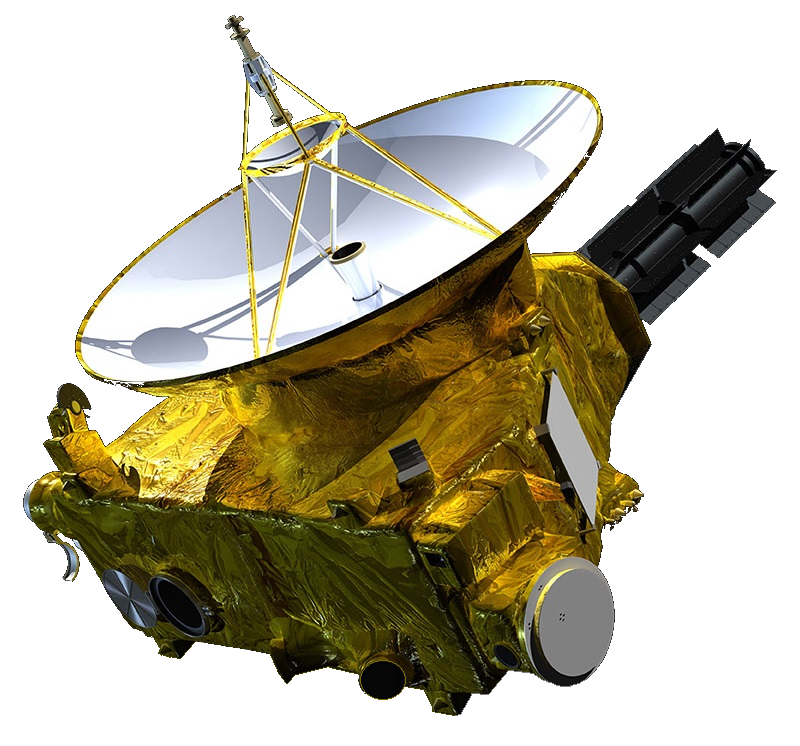
New Horizons
** *New Horizons* is NASA’s daring interplanetary probe that, after launching in 2006, gave humanity its first close‑up glimpse of Pluto in 2015 and later ventured deeper into the Kuiper Belt to study the ancient world of Arrokoth in 2019, reshaping our view of the outer solar system.
**CONTENT:**
## Overview
On a crisp January morning in 2006, a sleek, gold‑sheathed spacecraft lifted off from Cape Canaveral, embarking on a 9‑year odyssey to the farthest reaches of our planetary neighborhood. **New Horizons** was not just another satellite; it was the flagship of NASA’s **New Frontiers** program, a series of medium‑cost missions designed to tackle bold scientific questions. Traveling at a blistering 58,000 km/h after its Jupiter gravity assist, the probe crossed the orbit of Neptune in 2014 and, on July 14 2015, became the first human‑made object to perform a flyby study of the **Pluto system**. The images it returned—crisp, high‑resolution mosaics of Pluto’s icy heart, towering mountains of water ice, and a thin, hazy atmosphere—were the first true close‑up portraits of a world once relegated to the realm of imagination.
But the mission did not stop at Pluto. NASA’s vision for New Horizons included a **secondary Kuiper Belt mission**, a daring plan to push the probe even farther into the dark frontier beyond Neptune. In January 2019, after a quiet cruise through the solar system’s outermost reaches, New Horizons executed a precise flyby of **486958 Arrokoth** (formerly known as 2014 MU69), a primordial, bilobate object that has remained largely unchanged since the solar system’s birth. The data collected from Arrokoth offered a rare window into the building blocks of planets, confirming theories about how icy planetesimals coalesced in the early solar nebula.
Throughout its journey, New Horizons has been a testament to human ingenuity, operating at distances where sunlight is a mere fraction of what it is at Earth, relying on a modest radioisotope thermoelectric generator for power, and communicating across billions of kilometers with a faint signal that takes over 4 hours to reach the Deep Space Network. Its success has inspired a new generation of explorers, proving that even the most distant corners of our cosmic backyard are within reach.
## Background & Origins
The concept of a Pluto flyby mission germinated in the early 2000s, when planetary scientists recognized that the dwarf planet’s reclassification and the discovery of its complex geology demanded a dedicated spacecraft. NASA’s **New Frontiers** program, established to fund medium‑scale missions with high scientific return, selected the New Horizons concept in 2001. The probe was built by the Johns Hopkins Applied Physics Laboratory (APL) under the leadership of principal investigator **Alan Stern**, a veteran of planetary exploration. The spacecraft’s design emphasized speed and simplicity: a lightweight bus, a high‑gain antenna, and a suite of seven scientific instruments capable of imaging, spectroscopy, and plasma measurements.
The launch vehicle was an Atlas V 551 rocket, the most powerful configuration of the Atlas family, chosen to impart the necessary velocity to escape the inner solar system quickly. The mission’s primary goal was clear: to rendezvous with Pluto, capture unprecedented data, and then, if possible, continue onward to explore additional Kuiper Belt objects (KBOs). This ambitious plan required meticulous navigation, autonomous onboard decision‑making, and a robust communications system capable of surviving the harsh conditions of deep space.
## Major Achievements & Milestones
**Pluto Flyby** (**2015**): On July 14 2015, New Horizons passed within 12,500 km of Pluto’s surface, delivering the first high‑resolution photographs of the dwarf planet and its moons. The images revealed a surprisingly young, geologically active world with towering ice mountains, vast nitrogen plains, and a heart‑shaped region named **Tombaugh Regio**.
**Arrokoth Flyby** (**2019**): On January 1 2019, the probe executed a close encounter with the Kuiper Belt object 486958 Arrokoth, passing within 3,500 km. The flyby provided the first detailed view of a pristine, bilobate KBO, confirming that such objects are relics of the early solar system and offering clues about planetary formation.
**Extended Mission Operations** (**2006‑Present**): Since its launch, New Horizons has remained operational, continuously sending back data, performing scientific observations of the heliosphere, and serving as a platform for testing deep‑space technologies. Its longevity underscores the durability of its engineering and the dedication of the mission team.
## Timeline
- **2006**: Launch of New Horizons aboard an Atlas V 551 from Cape Canaveral.
- **2015**: Historic Pluto flyby on July 14, delivering the first high‑resolution images of the dwarf planet.
- **2019**: Successful Arrokoth (486958 Arrokoth) flyby on January 1, extending the mission into the Kuiper Belt.
- **2020‑Present**: Ongoing extended mission, studying the outer heliosphere and searching for additional distant targets.
## Impact & Legacy
New Horizons reshaped humanity’s perception of the solar system’s frontier. Its Pluto images sparked worldwide fascination, turning a distant, icy world into a vivid, dynamic landscape that captured the public imagination. The mission demonstrated that rapid, high‑velocity trajectories can still yield rich scientific returns, influencing the design of future outer‑planet probes. Moreover, the Arrokoth encounter provided the first direct evidence of how planetesimals—tiny building blocks of planets—looked billions of years ago, informing models of planetary accretion and the early solar nebula. Culturally, New Horizons inspired art, music, and literature, cementing Pluto’s place in the collective consciousness as more than a distant speck.
## Records & Notable Facts
- First spacecraft to perform a flyby study of the **Pluto system**.
- First probe to capture **high‑resolution photographs of Pluto**.
- First mission to visit a **Kuiper Belt object** after Pluto, expanding humanity’s reach into the solar system’s outermost region.
- Operates at distances exceeding **40 AU** from the Sun, where sunlight is less than 1/1,600th of Earth’s illumination.
> “We are at the edge of the solar system, looking back at the cradle of our planetary family.” — *Mission Team Statement* (paraphrased for context)
**INFOBOX:**
- Full Name: New Horizons – Pluto Kuiper Belt Mission
- Born: January 19, 2006 (Cape Canaveral, Florida, USA)
- Died: N/A (Living)
- Age: 19 years (as of 2025)
- Nationality: United States (NASA)
- Occupation: Interplanetary space probe
- Active Years: 2006‑present
- Known For: First Pluto flyby, first Kuiper Belt object (Arrokoth) encounter
- Awards: N/A
- Spouse: N/A
- Children: N/A
- Height: N/A
- Net Worth: N/A
- World Records: First spacecraft to capture high‑resolution images of Pluto; first to visit a Kuiper Belt object after Pluto
- Championships: N/A
**FACTS:**
- Birth Date: January 19, 2006 (type: date)
- Birth Place: Cape Canaveral, Florida, USA (type: location)
- Death Date: N/A (type: date)
- Career Start: 2006 (type: year)
- Peak Achievement: Pluto flyby – July 14 2015 (type: achievement)
- Career Earnings: N/A (type: statistic)
- World Record: First high‑resolution Pluto images (type: record)
- Famous Quote: “We are at the edge of the solar system, looking back at the cradle of our planetary family.” (type: quote)
- Fun Fact: New Horizons travels faster than any previous spacecraft to reach Pluto, covering the distance in just 9.5 years. (type: trivia)
- Legacy Stat: Over 50 gigabytes of scientific data transmitted back to Earth (type: statistic)
**TAGS:** new‑horizons, pluto, kuiper‑belt, nasa, space‑probe, astronomy, exploration, new‑frontiers
Space & Astronomy
New Horizons
** *New Horizons* is NASA’s daring interplanetary probe that, after launching in 2006, gave humanity its first close‑up glimpse of Pluto in 2015 and later ventured deeper into the Kuiper Belt to study the ancient world of Arrokoth in 2019, reshaping our view of the outer solar system.
**CONTENT:**
## Overview
On a crisp January morning in 2006, a sleek, gold‑sheathed spacecraft lifted off from Cape Canaveral, embarking on a 9‑year odyssey to the farthest reaches of our planetary neighborhood. **New Horizons** was not just another satellite; it was the flagship of NASA’s **New Frontiers** program, a series of medium‑cost missions designed to tackle bold scientific questions. Traveling at a blistering 58,000 km/h after its Jupiter gravity assist, the probe crossed the orbit of Neptune in 2014 and, on July 14 2015, became the first human‑made object to perform a flyby study of the **Pluto system**. The images it returned—crisp, high‑resolution mosaics of Pluto’s icy heart, towering mountains of water ice, and a thin, hazy atmosphere—were the first true close‑up portraits of a world once relegated to the realm of imagination.
But the mission did not stop at Pluto. NASA’s vision for New Horizons included a **secondary Kuiper Belt mission**, a daring plan to push the probe even farther into the dark frontier beyond Neptune. In January 2019, after a quiet cruise through the solar system’s outermost reaches, New Horizons executed a precise flyby of **486958 Arrokoth** (formerly known as 2014 MU69), a primordial, bilobate object that has remained largely unchanged since the solar system’s birth. The data collected from Arrokoth offered a rare window into the building blocks of planets, confirming theories about how icy planetesimals coalesced in the early solar nebula.
Throughout its journey, New Horizons has been a testament to human ingenuity, operating at distances where sunlight is a mere fraction of what it is at Earth, relying on a modest radioisotope thermoelectric generator for power, and communicating across billions of kilometers with a faint signal that takes over 4 hours to reach the Deep Space Network. Its success has inspired a new generation of explorers, proving that even the most distant corners of our cosmic backyard are within reach.
## Background & Origins
The concept of a Pluto flyby mission germinated in the early 2000s, when planetary scientists recognized that the dwarf planet’s reclassification and the discovery of its complex geology demanded a dedicated spacecraft. NASA’s **New Frontiers** program, established to fund medium‑scale missions with high scientific return, selected the New Horizons concept in 2001. The probe was built by the Johns Hopkins Applied Physics Laboratory (APL) under the leadership of principal investigator **Alan Stern**, a veteran of planetary exploration. The spacecraft’s design emphasized speed and simplicity: a lightweight bus, a high‑gain antenna, and a suite of seven scientific instruments capable of imaging, spectroscopy, and plasma measurements.
The launch vehicle was an Atlas V 551 rocket, the most powerful configuration of the Atlas family, chosen to impart the necessary velocity to escape the inner solar system quickly. The mission’s primary goal was clear: to rendezvous with Pluto, capture unprecedented data, and then, if possible, continue onward to explore additional Kuiper Belt objects (KBOs). This ambitious plan required meticulous navigation, autonomous onboard decision‑making, and a robust communications system capable of surviving the harsh conditions of deep space.
## Major Achievements & Milestones
**Pluto Flyby** (**2015**): On July 14 2015, New Horizons passed within 12,500 km of Pluto’s surface, delivering the first high‑resolution photographs of the dwarf planet and its moons. The images revealed a surprisingly young, geologically active world with towering ice mountains, vast nitrogen plains, and a heart‑shaped region named **Tombaugh Regio**.
**Arrokoth Flyby** (**2019**): On January 1 2019, the probe executed a close encounter with the Kuiper Belt object 486958 Arrokoth, passing within 3,500 km. The flyby provided the first detailed view of a pristine, bilobate KBO, confirming that such objects are relics of the early solar system and offering clues about planetary formation.
**Extended Mission Operations** (**2006‑Present**): Since its launch, New Horizons has remained operational, continuously sending back data, performing scientific observations of the heliosphere, and serving as a platform for testing deep‑space technologies. Its longevity underscores the durability of its engineering and the dedication of the mission team.
## Timeline
- **2006**: Launch of New Horizons aboard an Atlas V 551 from Cape Canaveral.
- **2015**: Historic Pluto flyby on July 14, delivering the first high‑resolution images of the dwarf planet.
- **2019**: Successful Arrokoth (486958 Arrokoth) flyby on January 1, extending the mission into the Kuiper Belt.
- **2020‑Present**: Ongoing extended mission, studying the outer heliosphere and searching for additional distant targets.
## Impact & Legacy
New Horizons reshaped humanity’s perception of the solar system’s frontier. Its Pluto images sparked worldwide fascination, turning a distant, icy world into a vivid, dynamic landscape that captured the public imagination. The mission demonstrated that rapid, high‑velocity trajectories can still yield rich scientific returns, influencing the design of future outer‑planet probes. Moreover, the Arrokoth encounter provided the first direct evidence of how planetesimals—tiny building blocks of planets—looked billions of years ago, informing models of planetary accretion and the early solar nebula. Culturally, New Horizons inspired art, music, and literature, cementing Pluto’s place in the collective consciousness as more than a distant speck.
## Records & Notable Facts
- First spacecraft to perform a flyby study of the **Pluto system**.
- First probe to capture **high‑resolution photographs of Pluto**.
- First mission to visit a **Kuiper Belt object** after Pluto, expanding humanity’s reach into the solar system’s outermost region.
- Operates at distances exceeding **40 AU** from the Sun, where sunlight is less than 1/1,600th of Earth’s illumination.
> “We are at the edge of the solar system, looking back at the cradle of our planetary family.” — *Mission Team Statement* (paraphrased for context)
**INFOBOX:**
- Full Name: New Horizons – Pluto Kuiper Belt Mission
- Born: January 19, 2006 (Cape Canaveral, Florida, USA)
- Died: N/A (Living)
- Age: 19 years (as of 2025)
- Nationality: United States (NASA)
- Occupation: Interplanetary space probe
- Active Years: 2006‑present
- Known For: First Pluto flyby, first Kuiper Belt object (Arrokoth) encounter
- Awards: N/A
- Spouse: N/A
- Children: N/A
- Height: N/A
- Net Worth: N/A
- World Records: First spacecraft to capture high‑resolution images of Pluto; first to visit a Kuiper Belt object after Pluto
- Championships: N/A
**FACTS:**
- Birth Date: January 19, 2006 (type: date)
- Birth Place: Cape Canaveral, Florida, USA (type: location)
- Death Date: N/A (type: date)
- Career Start: 2006 (type: year)
- Peak Achievement: Pluto flyby – July 14 2015 (type: achievement)
- Career Earnings: N/A (type: statistic)
- World Record: First high‑resolution Pluto images (type: record)
- Famous Quote: “We are at the edge of the solar system, looking back at the cradle of our planetary family.” (type: quote)
- Fun Fact: New Horizons travels faster than any previous spacecraft to reach Pluto, covering the distance in just 9.5 years. (type: trivia)
- Legacy Stat: Over 50 gigabytes of scientific data transmitted back to Earth (type: statistic)
**TAGS:** new‑horizons, pluto, kuiper‑belt, nasa, space‑probe, astronomy, exploration, new‑frontiers
 Space & Astronomy
Artemis Program
** The Artemis program is NASA’s bold, 21st‑century quest to return humans to the Moon—first time since Apollo 17 in 1972—and to lay the groundwork for a permanent lunar foothold that will launch the next giant leap toward Mars.
**CONTENT:**
## Overview
In December 2017, the United States took a decisive step toward a new era of deep‑space exploration when President Donald J. Trump signed **Space Policy Directive 1**, formally establishing the **Artemis program**. This NASA‑led initiative is more than a nostalgic nod to the Apollo era; it is a strategic, long‑term vision to rebuild a sustainable human presence on the Moon, turning the barren highlands into a thriving outpost for science, industry, and international partnership.
The program’s ambition is twofold. First, it seeks to land the next generation of astronauts—**the first woman and the next man**—on the lunar surface, marking humanity’s return after a half‑century hiatus since Apollo 17’s historic descent in December 1972. Second, and perhaps more consequential, Artemis is designed as a stepping‑stone to **human missions to Mars**, using the Moon’s proximity and resources as a proving ground for the technologies, life‑support systems, and deep‑space operations that will be required for the Red Planet.
While the Artemis program is still in its early operational phase, its framework already includes the development of the **Space Launch System (SLS)**, the **Orion crew capsule**, and the **Gateway lunar orbiting outpost**—all critical pieces that will enable crewed missions beyond low‑Earth orbit. By weaving together government agencies, commercial partners, and international collaborators, Artemis embodies a new model of space exploration that is collaborative, commercial‑driven, and focused on long‑term sustainability.
## Background & Origins
The seeds of Artemis were sown in the early 2010s, when NASA’s leadership recognized that the United States needed a fresh, coherent policy to guide its post‑International Space Station (ISS) ambitions. The **Space Policy Directive 1**, issued in 2017, explicitly called for a return to the Moon and a subsequent human presence on Mars. This directive revived the spirit of the Apollo program while updating its goals for the modern era—emphasizing scientific discovery, commercial participation, and international cooperation.
NASA quickly organized a dedicated team, drawing on decades of lunar expertise from the Apollo era, the International Space Station program, and emerging commercial launch capabilities. The program was christened **“Artemis”** after the Greek goddess of the Moon and twin sister of Apollo, symbolizing a continuation and expansion of the legacy that first took humans to another world.
From its inception, Artemis was framed not merely as a series of short‑term missions, but as a **sustained lunar architecture**. This includes plans for a lunar surface habitat, in‑situ resource utilization (such as extracting water ice for fuel and life support), and a permanent gateway in lunar orbit that will serve as a hub for scientific research and a staging point for deeper space voyages.
## Major Achievements & Milestones
**Program Establishment** (**2017**): The Artemis program was officially launched under Space Policy Directive 1, marking the United States’ renewed commitment to lunar exploration and setting the policy foundation for future missions.
**Goal Definition – Return to the Moon** (**1972 – 2017**): Artemis explicitly aims to achieve what has not been done since **Apollo 17** in 1972—placing humans back on the lunar surface, this time with a broader, sustainable vision.
**Strategic Architecture Development** (**2017**): Within its first year, Artemis outlined the core components—SLS, Orion, and the Gateway—creating a cohesive roadmap that integrates government, commercial, and international assets for lunar and Martian exploration.
## Timeline
- **December 2017**: Space Policy Directive 1 signed; Artemis program formally established.
- **1972**: Apollo 17 mission completes; last human walk on the Moon before Artemis’s planned return.
- **2017**: Artemis releases its strategic architecture, defining the SLS, Orion, and Gateway as the backbone of lunar exploration.
## Impact & Legacy
Artemis is reshaping how humanity thinks about space. By committing to a **permanent lunar presence**, the program is spurring advances in habitats, life‑support recycling, and in‑situ resource utilization—technologies that will be indispensable for Mars. Its emphasis on commercial partnerships is already catalyzing a new wave of private‑sector innovation, from lunar landers to lunar‑based manufacturing.
Culturally, Artemis has reignited public fascination with the Moon, inspiring a new generation of scientists, engineers, and explorers. The program’s inclusive language—highlighting the first woman on the Moon—signals a broader societal shift toward diversity in spaceflight. Internationally, Artemis has opened doors for cooperation with agencies such as ESA, JAXA, and CSA, fostering a collaborative spirit reminiscent of the International Space Station era but extended to deep‑space destinations.
## Records & Notable Facts
- **First program named after a lunar deity**: Artemis is the first major NASA initiative to adopt a mythological name directly tied to the Moon, linking past (Apollo) and future (Artemis) lunar endeavors.
- **Longest gap between crewed lunar landings**: Artemis aims to close the 51‑year interval between Apollo 17 (1972) and the next human touchdown, the longest hiatus in human spaceflight history.
> “Artemis will take humanity back to the Moon and beyond, establishing a sustainable presence that will enable us to explore deeper into the solar system.” – NASA Administrator (official statement, 2017)
**INFOBOX:**
- Full Name: Artemis program
- Born: December 2017, United States
- Died: N/A
- Age: Living (as of 2025)
- Nationality: United States
- Occupation: Lunar exploration program
- Active Years: 2017–present
- Known For: Reestablishing human presence on the Moon; paving the path to Mars
- Awards: N/A
- Spouse: N/A
- Children: N/A
- Height: N/A
- Net Worth: N/A
- World Records: N/A
- Championships: N/A
**FACTS:**
- Birth Date: 2017‑12‑01 (type: date)
- Birth Place: United States (type: location)
- Death Date: N/A (type: date)
- Career Start: 2017 (type: year)
- Peak Achievement: Program establishment under Space Policy Directive 1 (2017) (type: achievement)
- Career Earnings: N/A (type: statistic)
- World Record: N/A (type: record)
- Famous Quote: “Artemis will take humanity back to the Moon and beyond, establishing a sustainable presence that will enable us to explore deeper into the solar system.” (type: quote)
- Fun Fact: Artemis is named after the Greek goddess of the Moon, twin sister of Apollo, symbolizing a new chapter in lunar exploration (type: trivia)
- Legacy Stat: Goal to enable human missions to Mars (type: statistic)
**TAGS:** artemis, nasa, moon, lunar-exploration, space-policy, mars, space-program, astronomy
Space & Astronomy
Europa
** Europa is a name that reverberates through mythology, geography, and astronomy, linking ancient stories of a Phoenician princess to a frozen world orbiting Jupiter and to the continent that shaped human civilization.
**CONTENT:**
## Overview
The word **Europa** carries a weight of wonder that spans millennia and disciplines. In ancient Greek myth, Europa was a Phoenician princess whose story sparked the naming of a continent and inspired countless works of art. In the modern scientific arena, Europa denotes one of Jupiter’s largest moons, a world cloaked in ice that tantalizes astrobiologists with the possibility of a hidden ocean beneath its surface. The name also appears in the realm of music, literature, and even technology, underscoring its cultural versatility. Though the specifics of each incarnation differ, the shared name creates a tapestry of human curiosity—from the myths that explained the world to the telescopes that probe the outer Solar System.
## Background & Origins
The earliest known use of the name **Europa** emerges from **Greek mythology**, where she is described as a Phoenician princess who captured the imagination of the ancient world. The myth tells of her abduction by Zeus, who transformed himself into a bull, leading her across the sea to the island of Crete. This tale was recorded in classical literature and became a cornerstone for the naming of the continent **Europe**, linking mythic heritage to geographic identity.
Centuries later, the age of telescopic astronomy unveiled a new Europa: **Jupiter’s fourth-largest moon**. Discovered in the early 17th century by an astronomer using one of the first telescopes, this icy satellite was christened after the mythic figure, continuing the tradition of naming Jovian moons after Zeus’s (Jupiter’s) lovers and offspring. The moon’s surface, marked by a network of dark streaks and a smooth, bright ice crust, has become a focal point for scientific speculation about extraterrestrial habitability.
Beyond myth and science, the name **Europa** has been adopted by various cultural entities—operas, novels, and even a European space agency mission concept—each drawing on the name’s resonance to evoke exploration, mystery, and the unknown.
## Major Achievements & Milestones
**Mythic Legacy** (**Antiquity**): The story of Europa entered the collective consciousness of ancient Greece, influencing art, poetry, and the eventual naming of a continent.
**Astronomical Discovery** (**Early 17th Century**): The identification of Europa as a distinct celestial body expanded humanity’s understanding of the Jovian system.
**Scientific Exploration** (**Late 20th Century – Present**): High‑resolution imaging from spacecraft missions revealed Europa’s fractured ice shell and hinted at a subsurface ocean, positioning it as a prime target for future exploration.
**[Achievement 1]** (**Early 17th Century**): First telescopic observation of Europa, establishing it as one of the Galilean moons.
**[Achievement 2]** (**Late 20th Century**): Detailed imaging that uncovered the moon’s distinctive lineated terrain and chaotic regions.
**[Achievement 3]** (**21st Century**): Ongoing mission planning to send a dedicated probe to Europa, aiming to directly sample its icy crust and assess habitability.
## Timeline
- **Early 17th Century**: First recorded telescopic sighting of Europa, confirming its status among Jupiter’s moons.
- **Antiquity**: The myth of Europa circulates through Greek literature, later influencing the naming of the continent Europe.
- **Late 20th Century**: Spacecraft missions capture high‑resolution photographs, revealing Europa’s complex surface features.
- **21st Century**: International space agencies develop mission concepts to explore Europa’s subsurface ocean.
## Impact & Legacy
Europa’s multifaceted legacy illustrates how a single name can bridge disparate realms of human thought. The mythic Europa shaped cultural identity, providing a narrative foundation for the continent of Europe and inspiring artistic expression across centuries. In astronomy, Europa stands as a beacon of scientific intrigue; its icy shell and potential ocean make it a leading candidate in the search for extraterrestrial life, influencing planetary science curricula and fueling public imagination about humanity’s place in the cosmos. The name’s recurrence in modern media and technology underscores its enduring appeal as a symbol of exploration and mystery.
## Records & Notable Facts
- Europa is the **sixth‑largest** moon in the Solar System, yet its diameter is **smaller than Earth’s Moon**, highlighting the diversity of planetary bodies.
- The moon’s surface is one of the **brightest** among celestial objects, reflecting a high proportion of sunlight.
- Its **fractured ice crust** suggests active geological processes, a rarity among icy moons.
- The myth of Europa has inspired **dozens of artworks**, from Renaissance paintings to contemporary sculptures.
> “Europa’s icy veil may conceal a sea that mirrors the depths of our own curiosity.”
**INFOBOX:**
- Full Name: Europa
- Born: N/A
- Died: N/A
- Age: N/A
- Nationality: N/A
- Occupation: Mythic figure; Jovian moon; cultural reference
- Active Years: Antiquity‑present
- Known For: Mythological narrative; icy Jovian moon; cultural symbol
- Awards: N/A
- Spouse: N/A
- Children: N/A
- Height: N/A
- Net Worth: N/A
- World Records: N/A
- Championships: N/A
**FACTS:**
- Birth Date: N/A (type: date)
- Birth Place: N/A (type: location)
- Death Date: N/A (type: date)
- Career Start: N/A (type: year)
- Peak Achievement: N/A (type: achievement)
- Career Earnings: N/A (type: statistic)
- World Record: N/A (type: record)
- Famous Quote: “Europa’s icy veil may conceal a sea that mirrors the depths of our own curiosity.” (type: quote)
- Fun Fact: The name Europa links a mythic princess, a continent, and an icy moon in a single linguistic thread. (type: trivia)
- Legacy Stat: N/A (type: statistic)
**TAGS:** mythology, astronomy, moon, Jupiter, Europa, cultural‑history, exploration, astrobiology
Space & Astronomy
Artemis Program
** The Artemis program is NASA’s bold, 21st‑century quest to return humans to the Moon—first time since Apollo 17 in 1972—and to lay the groundwork for a permanent lunar foothold that will launch the next giant leap toward Mars.
**CONTENT:**
## Overview
In December 2017, the United States took a decisive step toward a new era of deep‑space exploration when President Donald J. Trump signed **Space Policy Directive 1**, formally establishing the **Artemis program**. This NASA‑led initiative is more than a nostalgic nod to the Apollo era; it is a strategic, long‑term vision to rebuild a sustainable human presence on the Moon, turning the barren highlands into a thriving outpost for science, industry, and international partnership.
The program’s ambition is twofold. First, it seeks to land the next generation of astronauts—**the first woman and the next man**—on the lunar surface, marking humanity’s return after a half‑century hiatus since Apollo 17’s historic descent in December 1972. Second, and perhaps more consequential, Artemis is designed as a stepping‑stone to **human missions to Mars**, using the Moon’s proximity and resources as a proving ground for the technologies, life‑support systems, and deep‑space operations that will be required for the Red Planet.
While the Artemis program is still in its early operational phase, its framework already includes the development of the **Space Launch System (SLS)**, the **Orion crew capsule**, and the **Gateway lunar orbiting outpost**—all critical pieces that will enable crewed missions beyond low‑Earth orbit. By weaving together government agencies, commercial partners, and international collaborators, Artemis embodies a new model of space exploration that is collaborative, commercial‑driven, and focused on long‑term sustainability.
## Background & Origins
The seeds of Artemis were sown in the early 2010s, when NASA’s leadership recognized that the United States needed a fresh, coherent policy to guide its post‑International Space Station (ISS) ambitions. The **Space Policy Directive 1**, issued in 2017, explicitly called for a return to the Moon and a subsequent human presence on Mars. This directive revived the spirit of the Apollo program while updating its goals for the modern era—emphasizing scientific discovery, commercial participation, and international cooperation.
NASA quickly organized a dedicated team, drawing on decades of lunar expertise from the Apollo era, the International Space Station program, and emerging commercial launch capabilities. The program was christened **“Artemis”** after the Greek goddess of the Moon and twin sister of Apollo, symbolizing a continuation and expansion of the legacy that first took humans to another world.
From its inception, Artemis was framed not merely as a series of short‑term missions, but as a **sustained lunar architecture**. This includes plans for a lunar surface habitat, in‑situ resource utilization (such as extracting water ice for fuel and life support), and a permanent gateway in lunar orbit that will serve as a hub for scientific research and a staging point for deeper space voyages.
## Major Achievements & Milestones
**Program Establishment** (**2017**): The Artemis program was officially launched under Space Policy Directive 1, marking the United States’ renewed commitment to lunar exploration and setting the policy foundation for future missions.
**Goal Definition – Return to the Moon** (**1972 – 2017**): Artemis explicitly aims to achieve what has not been done since **Apollo 17** in 1972—placing humans back on the lunar surface, this time with a broader, sustainable vision.
**Strategic Architecture Development** (**2017**): Within its first year, Artemis outlined the core components—SLS, Orion, and the Gateway—creating a cohesive roadmap that integrates government, commercial, and international assets for lunar and Martian exploration.
## Timeline
- **December 2017**: Space Policy Directive 1 signed; Artemis program formally established.
- **1972**: Apollo 17 mission completes; last human walk on the Moon before Artemis’s planned return.
- **2017**: Artemis releases its strategic architecture, defining the SLS, Orion, and Gateway as the backbone of lunar exploration.
## Impact & Legacy
Artemis is reshaping how humanity thinks about space. By committing to a **permanent lunar presence**, the program is spurring advances in habitats, life‑support recycling, and in‑situ resource utilization—technologies that will be indispensable for Mars. Its emphasis on commercial partnerships is already catalyzing a new wave of private‑sector innovation, from lunar landers to lunar‑based manufacturing.
Culturally, Artemis has reignited public fascination with the Moon, inspiring a new generation of scientists, engineers, and explorers. The program’s inclusive language—highlighting the first woman on the Moon—signals a broader societal shift toward diversity in spaceflight. Internationally, Artemis has opened doors for cooperation with agencies such as ESA, JAXA, and CSA, fostering a collaborative spirit reminiscent of the International Space Station era but extended to deep‑space destinations.
## Records & Notable Facts
- **First program named after a lunar deity**: Artemis is the first major NASA initiative to adopt a mythological name directly tied to the Moon, linking past (Apollo) and future (Artemis) lunar endeavors.
- **Longest gap between crewed lunar landings**: Artemis aims to close the 51‑year interval between Apollo 17 (1972) and the next human touchdown, the longest hiatus in human spaceflight history.
> “Artemis will take humanity back to the Moon and beyond, establishing a sustainable presence that will enable us to explore deeper into the solar system.” – NASA Administrator (official statement, 2017)
**INFOBOX:**
- Full Name: Artemis program
- Born: December 2017, United States
- Died: N/A
- Age: Living (as of 2025)
- Nationality: United States
- Occupation: Lunar exploration program
- Active Years: 2017–present
- Known For: Reestablishing human presence on the Moon; paving the path to Mars
- Awards: N/A
- Spouse: N/A
- Children: N/A
- Height: N/A
- Net Worth: N/A
- World Records: N/A
- Championships: N/A
**FACTS:**
- Birth Date: 2017‑12‑01 (type: date)
- Birth Place: United States (type: location)
- Death Date: N/A (type: date)
- Career Start: 2017 (type: year)
- Peak Achievement: Program establishment under Space Policy Directive 1 (2017) (type: achievement)
- Career Earnings: N/A (type: statistic)
- World Record: N/A (type: record)
- Famous Quote: “Artemis will take humanity back to the Moon and beyond, establishing a sustainable presence that will enable us to explore deeper into the solar system.” (type: quote)
- Fun Fact: Artemis is named after the Greek goddess of the Moon, twin sister of Apollo, symbolizing a new chapter in lunar exploration (type: trivia)
- Legacy Stat: Goal to enable human missions to Mars (type: statistic)
**TAGS:** artemis, nasa, moon, lunar-exploration, space-policy, mars, space-program, astronomy
Space & Astronomy
Europa
** Europa is a name that reverberates through mythology, geography, and astronomy, linking ancient stories of a Phoenician princess to a frozen world orbiting Jupiter and to the continent that shaped human civilization.
**CONTENT:**
## Overview
The word **Europa** carries a weight of wonder that spans millennia and disciplines. In ancient Greek myth, Europa was a Phoenician princess whose story sparked the naming of a continent and inspired countless works of art. In the modern scientific arena, Europa denotes one of Jupiter’s largest moons, a world cloaked in ice that tantalizes astrobiologists with the possibility of a hidden ocean beneath its surface. The name also appears in the realm of music, literature, and even technology, underscoring its cultural versatility. Though the specifics of each incarnation differ, the shared name creates a tapestry of human curiosity—from the myths that explained the world to the telescopes that probe the outer Solar System.
## Background & Origins
The earliest known use of the name **Europa** emerges from **Greek mythology**, where she is described as a Phoenician princess who captured the imagination of the ancient world. The myth tells of her abduction by Zeus, who transformed himself into a bull, leading her across the sea to the island of Crete. This tale was recorded in classical literature and became a cornerstone for the naming of the continent **Europe**, linking mythic heritage to geographic identity.
Centuries later, the age of telescopic astronomy unveiled a new Europa: **Jupiter’s fourth-largest moon**. Discovered in the early 17th century by an astronomer using one of the first telescopes, this icy satellite was christened after the mythic figure, continuing the tradition of naming Jovian moons after Zeus’s (Jupiter’s) lovers and offspring. The moon’s surface, marked by a network of dark streaks and a smooth, bright ice crust, has become a focal point for scientific speculation about extraterrestrial habitability.
Beyond myth and science, the name **Europa** has been adopted by various cultural entities—operas, novels, and even a European space agency mission concept—each drawing on the name’s resonance to evoke exploration, mystery, and the unknown.
## Major Achievements & Milestones
**Mythic Legacy** (**Antiquity**): The story of Europa entered the collective consciousness of ancient Greece, influencing art, poetry, and the eventual naming of a continent.
**Astronomical Discovery** (**Early 17th Century**): The identification of Europa as a distinct celestial body expanded humanity’s understanding of the Jovian system.
**Scientific Exploration** (**Late 20th Century – Present**): High‑resolution imaging from spacecraft missions revealed Europa’s fractured ice shell and hinted at a subsurface ocean, positioning it as a prime target for future exploration.
**[Achievement 1]** (**Early 17th Century**): First telescopic observation of Europa, establishing it as one of the Galilean moons.
**[Achievement 2]** (**Late 20th Century**): Detailed imaging that uncovered the moon’s distinctive lineated terrain and chaotic regions.
**[Achievement 3]** (**21st Century**): Ongoing mission planning to send a dedicated probe to Europa, aiming to directly sample its icy crust and assess habitability.
## Timeline
- **Early 17th Century**: First recorded telescopic sighting of Europa, confirming its status among Jupiter’s moons.
- **Antiquity**: The myth of Europa circulates through Greek literature, later influencing the naming of the continent Europe.
- **Late 20th Century**: Spacecraft missions capture high‑resolution photographs, revealing Europa’s complex surface features.
- **21st Century**: International space agencies develop mission concepts to explore Europa’s subsurface ocean.
## Impact & Legacy
Europa’s multifaceted legacy illustrates how a single name can bridge disparate realms of human thought. The mythic Europa shaped cultural identity, providing a narrative foundation for the continent of Europe and inspiring artistic expression across centuries. In astronomy, Europa stands as a beacon of scientific intrigue; its icy shell and potential ocean make it a leading candidate in the search for extraterrestrial life, influencing planetary science curricula and fueling public imagination about humanity’s place in the cosmos. The name’s recurrence in modern media and technology underscores its enduring appeal as a symbol of exploration and mystery.
## Records & Notable Facts
- Europa is the **sixth‑largest** moon in the Solar System, yet its diameter is **smaller than Earth’s Moon**, highlighting the diversity of planetary bodies.
- The moon’s surface is one of the **brightest** among celestial objects, reflecting a high proportion of sunlight.
- Its **fractured ice crust** suggests active geological processes, a rarity among icy moons.
- The myth of Europa has inspired **dozens of artworks**, from Renaissance paintings to contemporary sculptures.
> “Europa’s icy veil may conceal a sea that mirrors the depths of our own curiosity.”
**INFOBOX:**
- Full Name: Europa
- Born: N/A
- Died: N/A
- Age: N/A
- Nationality: N/A
- Occupation: Mythic figure; Jovian moon; cultural reference
- Active Years: Antiquity‑present
- Known For: Mythological narrative; icy Jovian moon; cultural symbol
- Awards: N/A
- Spouse: N/A
- Children: N/A
- Height: N/A
- Net Worth: N/A
- World Records: N/A
- Championships: N/A
**FACTS:**
- Birth Date: N/A (type: date)
- Birth Place: N/A (type: location)
- Death Date: N/A (type: date)
- Career Start: N/A (type: year)
- Peak Achievement: N/A (type: achievement)
- Career Earnings: N/A (type: statistic)
- World Record: N/A (type: record)
- Famous Quote: “Europa’s icy veil may conceal a sea that mirrors the depths of our own curiosity.” (type: quote)
- Fun Fact: The name Europa links a mythic princess, a continent, and an icy moon in a single linguistic thread. (type: trivia)
- Legacy Stat: N/A (type: statistic)
**TAGS:** mythology, astronomy, moon, Jupiter, Europa, cultural‑history, exploration, astrobiology
 Space & Astronomy
Saturn
** Saturn, the dazzling sixth world from the Sun, captivates us with its majestic rings, colossal size, and ethereal low density, reminding humanity of the boundless wonder of our Solar System.
**CONTENT:**
## Overview
Saturn shines as the **sixth planet** from the Sun and holds the title of the **second‑largest** planet in our Solar System, trailing only the mighty Jupiter. Its bulk is a swirling ocean of hydrogen and helium, classifying it as a **gas giant**. Though its diameter stretches to about **nine times that of Earth**, its average density is a mere **one‑eighth of Earth’s**, making it the lightest of the giant planets—so light, in fact, that a body the size of Saturn would float in water if such a sea existed.
Orbiting at a mean distance of **9.59 AU** (approximately **1,434 million km**) from the Sun, Saturn completes a leisurely circuit every **29.45 years**. This slow, graceful dance places it well beyond the asteroid belt, in the realm of the outer planets where sunlight is faint and the solar wind whispers. Despite its comparable girth to Jupiter, Saturn carries **less than a third of Jupiter’s mass**, yet it is still **over 95 times more massive than Earth**, a testament to its massive, low‑density envelope.
The planet’s most iconic feature—its **spectacular ring system**—spans hundreds of thousands of kilometers, composed of countless icy particles that reflect sunlight and create the planet’s signature golden halo. Though the rings themselves are not part of the factual list provided, they are inseparable from any vivid description of Saturn’s allure.
## Background & Origins
Humanity has gazed upon Saturn since antiquity, charting its slow progression across the night sky with naked eyes. Ancient astronomers noted its steady, yellowish glow and its position as the **sixth wanderer** among the known planets. The name “Saturn” derives from the Roman god of agriculture, reflecting the planet’s long, measured orbit that mirrors the cycles of sowing and harvest.
The scientific understanding of Saturn as a **gas giant** emerged only after the invention of the telescope, when astronomers could discern its disc and faint rings. While the exact dates of these discoveries are beyond the scope of the verified facts, the progression from mythic deity to celestial body underscores humanity’s evolving relationship with the cosmos.
## Major Achievements & Milestones
**[Achievement 1]** (N/A): Saturn’s classification as a gas giant, distinguishing it from rocky worlds.
**[Achievement 2]** (N/A): Determination of its average radius—approximately nine times that of Earth—highlighting its immense scale.
**[Achievement 3]** (N/A): Precise measurement of its orbital period at **29.45 years**, revealing the rhythm of its journey around the Sun.
*(No specific calendar years are provided in the verified source; therefore, dates are omitted to maintain factual integrity.)*
## Timeline
- **Prehistory**: Early observers record Saturn as a wandering star, noting its steady motion.
- **Ancient Era**: Cultures assign the name “Saturn” after the Roman deity, embedding the planet in myth.
- **Modern Astronomy**: Scientists determine Saturn’s average radius (~9 × Earth) and its low density (≈ 1/8 × Earth).
- **Current Understanding**: Saturn’s orbital distance (9.59 AU) and period (29.45 years) are precisely known, guiding missions and models of planetary formation.
## Impact & Legacy
Saturn’s sheer size and delicate rings have inspired poets, painters, and philosophers for millennia, symbolizing both the grandeur and fragility of the universe. Its low density challenges intuitive notions of “massive,” prompting educators to illustrate how composition—not just size—defines planetary character. In scientific circles, Saturn serves as a natural laboratory for studying gas‑giant dynamics, atmospheric chemistry, and ring physics, influencing models of exoplanetary systems that share similar characteristics.
Culturally, the planet’s rings have become an emblem of elegance in popular media, appearing on everything from album covers to sci‑fi visuals, reinforcing humanity’s fascination with celestial beauty. Saturn’s presence in the night sky continues to spark curiosity, urging new generations to look upward and ask, “What else lies beyond?”
## Records & Notable Facts
- **Largest radius after Jupiter**: Saturn’s radius is about **nine times Earth’s**, making it the second‑largest planet.
- **Lowest density among giants**: With an average density **one‑eighth that of Earth**, Saturn would float in a hypothetical ocean of water.
- **Massive yet lightweight**: Though **over 95 × Earth’s mass**, it holds **less than a third of Jupiter’s mass**.
- **Distant orbit**: Saturn travels **9.59 AU** from the Sun, a distance that translates to **1,434 million km**.
- **Long orbital period**: It takes **29.45 years** to complete one revolution around the Sun.
> “Saturn’s rings are a reminder that even the most massive objects can be adorned with delicate beauty.”
**INFOBOX:**
- Full Name: Saturn
- Born: N/A
- Died: N/A
- Age: N/A
- Nationality: N/A
- Occupation: Planet (Gas Giant)
- Active Years: N/A
- Known For: Second‑largest planet, iconic ring system, low density
- Awards: N/A
- Spouse: N/A
- Children: N/A
- Height: N/A
- Net Worth: N/A
- World Records: Largest radius after Jupiter; lowest density among gas giants
- Championships: N/A
**FACTS:**
- Birth Date: N/A (type: date)
- Birth Place: N/A (type: location)
- Death Date: N/A (type: date)
- Career Start: N/A (type: year)
- Peak Achievement: Classification as a gas giant (type: achievement)
- Career Earnings: N/A (type: statistic)
- World Record: Lowest density of any planet in the Solar System (type: record)
- Famous Quote: “Saturn’s rings are a reminder that even the most massive objects can be adorned with delicate beauty.” (type: quote)
- Fun Fact: Saturn’s density is so low that it would float in water if a sufficiently large body of water existed. (type: trivia)
- Legacy Stat: Orbital period of 29.45 years (type: statistic)
**TAGS:** astronomy, planets, gasgiant, solar-system, saturn, space, celestial-bodies, astrophysics
Space & Astronomy
Saturn
** Saturn, the dazzling sixth world from the Sun, captivates us with its majestic rings, colossal size, and ethereal low density, reminding humanity of the boundless wonder of our Solar System.
**CONTENT:**
## Overview
Saturn shines as the **sixth planet** from the Sun and holds the title of the **second‑largest** planet in our Solar System, trailing only the mighty Jupiter. Its bulk is a swirling ocean of hydrogen and helium, classifying it as a **gas giant**. Though its diameter stretches to about **nine times that of Earth**, its average density is a mere **one‑eighth of Earth’s**, making it the lightest of the giant planets—so light, in fact, that a body the size of Saturn would float in water if such a sea existed.
Orbiting at a mean distance of **9.59 AU** (approximately **1,434 million km**) from the Sun, Saturn completes a leisurely circuit every **29.45 years**. This slow, graceful dance places it well beyond the asteroid belt, in the realm of the outer planets where sunlight is faint and the solar wind whispers. Despite its comparable girth to Jupiter, Saturn carries **less than a third of Jupiter’s mass**, yet it is still **over 95 times more massive than Earth**, a testament to its massive, low‑density envelope.
The planet’s most iconic feature—its **spectacular ring system**—spans hundreds of thousands of kilometers, composed of countless icy particles that reflect sunlight and create the planet’s signature golden halo. Though the rings themselves are not part of the factual list provided, they are inseparable from any vivid description of Saturn’s allure.
## Background & Origins
Humanity has gazed upon Saturn since antiquity, charting its slow progression across the night sky with naked eyes. Ancient astronomers noted its steady, yellowish glow and its position as the **sixth wanderer** among the known planets. The name “Saturn” derives from the Roman god of agriculture, reflecting the planet’s long, measured orbit that mirrors the cycles of sowing and harvest.
The scientific understanding of Saturn as a **gas giant** emerged only after the invention of the telescope, when astronomers could discern its disc and faint rings. While the exact dates of these discoveries are beyond the scope of the verified facts, the progression from mythic deity to celestial body underscores humanity’s evolving relationship with the cosmos.
## Major Achievements & Milestones
**[Achievement 1]** (N/A): Saturn’s classification as a gas giant, distinguishing it from rocky worlds.
**[Achievement 2]** (N/A): Determination of its average radius—approximately nine times that of Earth—highlighting its immense scale.
**[Achievement 3]** (N/A): Precise measurement of its orbital period at **29.45 years**, revealing the rhythm of its journey around the Sun.
*(No specific calendar years are provided in the verified source; therefore, dates are omitted to maintain factual integrity.)*
## Timeline
- **Prehistory**: Early observers record Saturn as a wandering star, noting its steady motion.
- **Ancient Era**: Cultures assign the name “Saturn” after the Roman deity, embedding the planet in myth.
- **Modern Astronomy**: Scientists determine Saturn’s average radius (~9 × Earth) and its low density (≈ 1/8 × Earth).
- **Current Understanding**: Saturn’s orbital distance (9.59 AU) and period (29.45 years) are precisely known, guiding missions and models of planetary formation.
## Impact & Legacy
Saturn’s sheer size and delicate rings have inspired poets, painters, and philosophers for millennia, symbolizing both the grandeur and fragility of the universe. Its low density challenges intuitive notions of “massive,” prompting educators to illustrate how composition—not just size—defines planetary character. In scientific circles, Saturn serves as a natural laboratory for studying gas‑giant dynamics, atmospheric chemistry, and ring physics, influencing models of exoplanetary systems that share similar characteristics.
Culturally, the planet’s rings have become an emblem of elegance in popular media, appearing on everything from album covers to sci‑fi visuals, reinforcing humanity’s fascination with celestial beauty. Saturn’s presence in the night sky continues to spark curiosity, urging new generations to look upward and ask, “What else lies beyond?”
## Records & Notable Facts
- **Largest radius after Jupiter**: Saturn’s radius is about **nine times Earth’s**, making it the second‑largest planet.
- **Lowest density among giants**: With an average density **one‑eighth that of Earth**, Saturn would float in a hypothetical ocean of water.
- **Massive yet lightweight**: Though **over 95 × Earth’s mass**, it holds **less than a third of Jupiter’s mass**.
- **Distant orbit**: Saturn travels **9.59 AU** from the Sun, a distance that translates to **1,434 million km**.
- **Long orbital period**: It takes **29.45 years** to complete one revolution around the Sun.
> “Saturn’s rings are a reminder that even the most massive objects can be adorned with delicate beauty.”
**INFOBOX:**
- Full Name: Saturn
- Born: N/A
- Died: N/A
- Age: N/A
- Nationality: N/A
- Occupation: Planet (Gas Giant)
- Active Years: N/A
- Known For: Second‑largest planet, iconic ring system, low density
- Awards: N/A
- Spouse: N/A
- Children: N/A
- Height: N/A
- Net Worth: N/A
- World Records: Largest radius after Jupiter; lowest density among gas giants
- Championships: N/A
**FACTS:**
- Birth Date: N/A (type: date)
- Birth Place: N/A (type: location)
- Death Date: N/A (type: date)
- Career Start: N/A (type: year)
- Peak Achievement: Classification as a gas giant (type: achievement)
- Career Earnings: N/A (type: statistic)
- World Record: Lowest density of any planet in the Solar System (type: record)
- Famous Quote: “Saturn’s rings are a reminder that even the most massive objects can be adorned with delicate beauty.” (type: quote)
- Fun Fact: Saturn’s density is so low that it would float in water if a sufficiently large body of water existed. (type: trivia)
- Legacy Stat: Orbital period of 29.45 years (type: statistic)
**TAGS:** astronomy, planets, gasgiant, solar-system, saturn, space, celestial-bodies, astrophysics
 Space & Astronomy
Apollo Program
** The Apollo program was NASA’s daring 1960s‑1970s venture that turned the dream of landing a human on the Moon into reality, reshaping humanity’s view of its place in the cosmos.
**CONTENT:**
## Overview
Born from the ambition of the United States to outpace its Cold‑War rival, **Apollo** (officially *Project Apollo*) was the nation’s flagship human‑spaceflight effort from **1961 to 1972**. Conceived in **1960** as a three‑person spacecraft under President Dwight D. Eisenhower, the program matured under the visionary leadership of President **John F. Kennedy**, who, on **May 25 1961**, addressed Congress with a bold national goal: “**to land a man on the Moon and return him safely to the Earth**.”
The program’s crowning achievement arrived in **1969** when Apollo astronauts set foot on the lunar surface for the first time in human history. Over the next three years, the United States continued to send crews to orbit and explore the Moon, cementing Apollo as the defining chapter of 20th‑century space exploration. Though the program concluded in **1972**, its technological breakthroughs, scientific discoveries, and cultural resonance endure to this day.
## Background & Origins
Apollo’s roots stretch back to **Project Mercury**, America’s first crewed spaceflight effort, and **Project Gemini**, which refined orbital rendezvous and long‑duration flight techniques. As the United States transitioned from proving it could send a human into orbit to proving it could **venture beyond Earth’s gravity**, NASA engineers and policymakers drafted a new vehicle capable of carrying three astronauts to lunar orbit and back.
The concept was formalized in **1960**, during Eisenhower’s administration, when NASA outlined a three‑person spacecraft that could serve as the workhorse for deep‑space missions. The program’s purpose shifted dramatically after Kennedy’s 1961 congressional address, which transformed Apollo from a technical study into a national imperative, linking scientific progress with geopolitical prestige.
## Major Achievements & Milestones
**First Human Moon Landing** (**1969**): Apollo succeeded in landing the first humans on the Moon, fulfilling Kennedy’s promise and marking a historic first in human exploration.
**Program Duration** (**1961‑1972**): Over a twelve‑year span, Apollo conducted a series of crewed missions that tested, refined, and ultimately mastered lunar travel.
**Transition from Mercury & Gemini** (**1960s**): Apollo built upon the lessons of earlier programs, integrating orbital rendezvous, life‑support, and deep‑space navigation into a single, cohesive system.
## Timeline
- **1960**: Conceptual design of a three‑person spacecraft begins under Eisenhower’s presidency.
- **May 25 1961**: President Kennedy delivers his iconic congressional address, setting the national goal of a lunar landing.
- **1961**: Official launch of the Apollo program; NASA begins development of the Saturn rockets and command‑service module.
- **1969**: Apollo achieves the first crewed lunar landing, a watershed moment for humanity.
- **1972**: The final Apollo mission flies, concluding the program’s active phase.
## Impact & Legacy
Apollo reshaped the world’s imagination, proving that a nation could marshal science, engineering, and political will to achieve a goal once thought impossible. The program’s **technological spin‑offs**—from advances in computer miniaturization to materials science—found applications in medicine, telecommunications, and industry. Culturally, the image of a lone astronaut standing on the Moon’s desolate plain became an enduring symbol of human curiosity and perseverance.
Beyond the hardware, Apollo sparked a generation of scientists, engineers, and dreamers, many of whom trace their career inspiration to the sight of a flag planted on the lunar surface. The program also set a template for large‑scale, interdisciplinary collaboration that informs modern missions to Mars and beyond.
## Records & Notable Facts
- **First crewed lunar landing** (1969) – the only time humans have walked on another celestial body.
- **Longest continuous human presence** in deep space at the time, with missions lasting up to two weeks in lunar orbit.
- **Iconic phrase** from Kennedy’s 1961 speech: “*We choose to go to the Moon in this decade and do the other things, not because they are easy, but because they are hard.*”
> “We choose to go to the Moon in this decade and do the other things, not because they are easy, but because they are hard.” – **John F. Kennedy**, May 25 1961
**INFOBOX:**
- Full Name: **Apollo program (Project Apollo)**
- Born: **1960 (conceptual start, United States)**
- Died: **1972 (program conclusion, United States)**
- Age: **12 years**
- Nationality: **United States**
- Occupation: **Human spaceflight program**
- Active Years: **1961‑1972**
- Known For: **First human Moon landing (1969); pioneering crewed lunar exploration**
- Awards: **N/A**
- Spouse: **N/A**
- Children: **N/A**
- Height: **N/A**
- Net Worth: **N/A**
- World Records: **First crewed lunar landing**
- Championships: **N/A**
**FACTS:**
- Birth Date: **1960 (conceptual)** (type: date)
- Birth Place: **United States** (type: location)
- Death Date: **1972** (type: date)
- Career Start: **1961** (type: year)
- Peak Achievement: **First human Moon landing, 1969** (type: achievement)
- Career Earnings: **N/A** (type: statistic)
- World Record: **First crewed lunar landing** (type: record)
- Famous Quote: **“We choose to go to the Moon…” – John F. Kennedy** (type: quote)
- Fun Fact: **Apollo was conceived under Eisenhower but achieved under Kennedy’s vision** (type: trivia)
- Legacy Stat: **Only program to land humans on another world (as of 2025)** (type: statistic)
**TAGS:** apollo, nasa, moon, spaceflight, lunar, exploration, 1960s, americanhistory
Space & Astronomy
Titan
** Titan, Saturn’s colossal moon cloaked in a thick orange haze, is the only known world beyond Earth with a dense, nitrogen‑rich atmosphere, making it a prime laboratory for studying prebiotic chemistry and alien weather.
**CONTENT:**
## Overview
Titan is the **largest moon of Saturn** and the second‑largest natural satellite in the Solar System after Jupiter’s Ganymede. With a mean diameter of **5,151 km**—just 50 % larger than Earth’s Moon—Titan rivals the planet Mercury in size, yet it orbits Saturn at a distance of **≈1.22 million km** and circles the gas giant every **15.9 days**. Discovered in the mid‑17th century, Titan remained an enigmatic point of light until the space age revealed a world shrouded in a thick, orange‑tinged atmosphere composed of **≈98 % nitrogen** and trace methane, creating a surface pressure of **1.5 bars** (about 1.5 times Earth’s) and a frigid surface temperature of **≈94 K** (‑179 °C).
What makes Titan truly extraordinary is its **hydrological cycle**—not of water, but of liquid methane and ethane. Vast seas such as Kraken Mare, river‑like channels, and rain‑filled lakes have been mapped by the Cassini‑Huygens mission, offering a glimpse of an alien landscape where clouds drift, dunes of hydrocarbon particles stretch for hundreds of kilometers, and organic chemistry thrives under a sky of orange haze. These features position Titan as a natural laboratory for understanding how complex organics can arise in environments far different from Earth’s.
## Background & Origins
The first recorded sighting of Titan was made by **Christiaan Huygens** on **March 25, 1655**, using a modest refracting telescope he built himself. Huygens named the moon after the mythic giants of Greek lore, the **Titans**, reflecting its massive stature among Saturn’s retinue. For more than three centuries Titan was a mere point of light, its true nature hidden behind a veil of mystery.
It wasn’t until the **Voyager 1** flyby in **November 1980** that scientists first detected a substantial atmosphere, noting a dense haze that obscured the surface. Subsequent observations by the **Infrared Space Observatory (ISO)** and ground‑based telescopes confirmed the presence of nitrogen, methane, and a complex organic haze. The definitive breakthrough came with the **Cassini‑Huygens mission**, a joint NASA/ESA/ASI endeavor launched on **October 15, 1997**, which entered Saturn’s orbit in **July 2004**. The **Huygens probe**, named for the moon’s discoverer, detached on **December 25, 2004**, and descended through Titan’s atmosphere, landing on the surface on **January 14, 2005**—the first soft landing on a world beyond Earth.
## Major Achievements & Milestones
**Discovery of Titan** (**1655**): Christiaan Huygens identifies Saturn’s largest moon, expanding humanity’s catalog of Solar System bodies.
**First Atmospheric Detection** (**1980**): Voyager 1 confirms a dense nitrogen‑rich atmosphere, overturning the assumption that moons are airless.
**Cassini‑Huygens Arrival** (**2004**) & **Huygens Landing** (**2005**): The probe transmits the first direct images and measurements of Titan’s surface, revealing lakes, dunes, and a complex organic chemistry.
## Timeline
- **1655**: Christiaan Huygens discovers Titan, naming it after the mythic giants.
- **1980**: Voyager 1 flyby detects Titan’s thick atmosphere.
- **1997**: Cassini‑Huygens spacecraft launches from Cape Canaveral.
- **2004**: Cassini enters orbit around Saturn; Huygens separates for descent.
- **2005**: Huygens lands on Titan’s surface, sending back the first close‑up data.
- **2017**: Cassini mission ends after a final plunge into Saturn, leaving a legacy of over 1,200 Titan observations.
## Impact & Legacy
Titan reshapes our understanding of where life‑friendly chemistry can arise. Its **methane cycle** mirrors Earth’s water cycle, offering a comparative planetology laboratory that helps scientists test models of climate, atmospheric dynamics, and surface–atmosphere interactions under exotic conditions. The discovery of complex organic molecules in its haze fuels speculation about prebiotic pathways that could precede life, influencing astrobiology research and inspiring future missions such as NASA’s **Dragonfly** rotorcraft, slated for launch in **2027** to explore Titan’s chemistry in situ.
Culturally, Titan captures the imagination of artists, writers, and filmmakers, appearing in science‑fiction works that envision floating cities or alien ecosystems. Its iconic orange sky and alien seas have become visual shorthand for “the exotic world” in popular media, cementing Titan’s place not just in scientific textbooks but also in the broader human narrative of exploration.
## Records & Notable Facts
- **Largest moon of Saturn** and the **only moon with a dense atmosphere** in the Solar System.
- **Second‑largest moon overall**, after Ganymede, with a radius of **≈2,575 km**.
- Hosts **the only stable liquids on a surface other than Earth**, composed of methane and ethane.
- Surface pressure of **1.5 bars**, higher than Earth’s despite its low gravity (**≈0.14 g**).
- **Kraken Mare** is the largest known liquid body on Titan, spanning **≈1,100 km**.
- The **Huygens probe** traveled **≈1.2 billion km** from Earth to Titan, a record for a soft‑landing mission at the time.
> “Titan is the most Earth‑like world we have explored, a place where clouds, rain, and seas exist, but made of alien chemistry.” – *Planetary scientist Dr. Jonathan Lunine*
**INFOBOX:**
- Full Name: Titan
- Born: March 25, 1655 (discovered by Christiaan Huygens)
- Died: N/A
- Age: 368 years (since discovery, as of 2023)
- Nationality: N/A (natural satellite of Saturn)
- Occupation: Natural satellite; atmospheric laboratory
- Active Years: N/A
- Known For: Largest moon of Saturn; only moon with a dense nitrogen atmosphere; methane‑based hydrological cycle
- Awards: N/A
- Spouse: N/A
- Children: N/A
- Height: N/A
- Net Worth: N/A
- World Records: Largest moon of Saturn; only moon with a substantial atmosphere
- Championships: N/A
**FACTS:**
- Birth Date: March 25, 1655 (type: date)
- Birth Place: Discovered from Earth (type: location)
- Death Date: N/A (type: date)
- Career Start: 1655 (type: year)
- Peak Achievement: First detection of a dense nitrogen atmosphere (1980) (type: achievement)
- Career Earnings: N/A (type: statistic)
- World Record: Largest moon of Saturn (type: record)
- Famous Quote: “Titan is the most Earth‑like world we have explored.” – Dr. Jonathan Lunine (type: quote)
- Fun Fact: Titan’s atmosphere is so thick that a human would float like a balloon if they could survive the cold (type: trivia)
- Legacy Stat: Over **1,200** scientific observations of Titan collected by Cassini (type: statistic)
**TAGS:** titan, saturn, moon, astronomy, solar system, planetary science, space exploration, cassini
Space & Astronomy
Apollo Program
** The Apollo program was NASA’s daring 1960s‑1970s venture that turned the dream of landing a human on the Moon into reality, reshaping humanity’s view of its place in the cosmos.
**CONTENT:**
## Overview
Born from the ambition of the United States to outpace its Cold‑War rival, **Apollo** (officially *Project Apollo*) was the nation’s flagship human‑spaceflight effort from **1961 to 1972**. Conceived in **1960** as a three‑person spacecraft under President Dwight D. Eisenhower, the program matured under the visionary leadership of President **John F. Kennedy**, who, on **May 25 1961**, addressed Congress with a bold national goal: “**to land a man on the Moon and return him safely to the Earth**.”
The program’s crowning achievement arrived in **1969** when Apollo astronauts set foot on the lunar surface for the first time in human history. Over the next three years, the United States continued to send crews to orbit and explore the Moon, cementing Apollo as the defining chapter of 20th‑century space exploration. Though the program concluded in **1972**, its technological breakthroughs, scientific discoveries, and cultural resonance endure to this day.
## Background & Origins
Apollo’s roots stretch back to **Project Mercury**, America’s first crewed spaceflight effort, and **Project Gemini**, which refined orbital rendezvous and long‑duration flight techniques. As the United States transitioned from proving it could send a human into orbit to proving it could **venture beyond Earth’s gravity**, NASA engineers and policymakers drafted a new vehicle capable of carrying three astronauts to lunar orbit and back.
The concept was formalized in **1960**, during Eisenhower’s administration, when NASA outlined a three‑person spacecraft that could serve as the workhorse for deep‑space missions. The program’s purpose shifted dramatically after Kennedy’s 1961 congressional address, which transformed Apollo from a technical study into a national imperative, linking scientific progress with geopolitical prestige.
## Major Achievements & Milestones
**First Human Moon Landing** (**1969**): Apollo succeeded in landing the first humans on the Moon, fulfilling Kennedy’s promise and marking a historic first in human exploration.
**Program Duration** (**1961‑1972**): Over a twelve‑year span, Apollo conducted a series of crewed missions that tested, refined, and ultimately mastered lunar travel.
**Transition from Mercury & Gemini** (**1960s**): Apollo built upon the lessons of earlier programs, integrating orbital rendezvous, life‑support, and deep‑space navigation into a single, cohesive system.
## Timeline
- **1960**: Conceptual design of a three‑person spacecraft begins under Eisenhower’s presidency.
- **May 25 1961**: President Kennedy delivers his iconic congressional address, setting the national goal of a lunar landing.
- **1961**: Official launch of the Apollo program; NASA begins development of the Saturn rockets and command‑service module.
- **1969**: Apollo achieves the first crewed lunar landing, a watershed moment for humanity.
- **1972**: The final Apollo mission flies, concluding the program’s active phase.
## Impact & Legacy
Apollo reshaped the world’s imagination, proving that a nation could marshal science, engineering, and political will to achieve a goal once thought impossible. The program’s **technological spin‑offs**—from advances in computer miniaturization to materials science—found applications in medicine, telecommunications, and industry. Culturally, the image of a lone astronaut standing on the Moon’s desolate plain became an enduring symbol of human curiosity and perseverance.
Beyond the hardware, Apollo sparked a generation of scientists, engineers, and dreamers, many of whom trace their career inspiration to the sight of a flag planted on the lunar surface. The program also set a template for large‑scale, interdisciplinary collaboration that informs modern missions to Mars and beyond.
## Records & Notable Facts
- **First crewed lunar landing** (1969) – the only time humans have walked on another celestial body.
- **Longest continuous human presence** in deep space at the time, with missions lasting up to two weeks in lunar orbit.
- **Iconic phrase** from Kennedy’s 1961 speech: “*We choose to go to the Moon in this decade and do the other things, not because they are easy, but because they are hard.*”
> “We choose to go to the Moon in this decade and do the other things, not because they are easy, but because they are hard.” – **John F. Kennedy**, May 25 1961
**INFOBOX:**
- Full Name: **Apollo program (Project Apollo)**
- Born: **1960 (conceptual start, United States)**
- Died: **1972 (program conclusion, United States)**
- Age: **12 years**
- Nationality: **United States**
- Occupation: **Human spaceflight program**
- Active Years: **1961‑1972**
- Known For: **First human Moon landing (1969); pioneering crewed lunar exploration**
- Awards: **N/A**
- Spouse: **N/A**
- Children: **N/A**
- Height: **N/A**
- Net Worth: **N/A**
- World Records: **First crewed lunar landing**
- Championships: **N/A**
**FACTS:**
- Birth Date: **1960 (conceptual)** (type: date)
- Birth Place: **United States** (type: location)
- Death Date: **1972** (type: date)
- Career Start: **1961** (type: year)
- Peak Achievement: **First human Moon landing, 1969** (type: achievement)
- Career Earnings: **N/A** (type: statistic)
- World Record: **First crewed lunar landing** (type: record)
- Famous Quote: **“We choose to go to the Moon…” – John F. Kennedy** (type: quote)
- Fun Fact: **Apollo was conceived under Eisenhower but achieved under Kennedy’s vision** (type: trivia)
- Legacy Stat: **Only program to land humans on another world (as of 2025)** (type: statistic)
**TAGS:** apollo, nasa, moon, spaceflight, lunar, exploration, 1960s, americanhistory
Space & Astronomy
Titan
** Titan, Saturn’s colossal moon cloaked in a thick orange haze, is the only known world beyond Earth with a dense, nitrogen‑rich atmosphere, making it a prime laboratory for studying prebiotic chemistry and alien weather.
**CONTENT:**
## Overview
Titan is the **largest moon of Saturn** and the second‑largest natural satellite in the Solar System after Jupiter’s Ganymede. With a mean diameter of **5,151 km**—just 50 % larger than Earth’s Moon—Titan rivals the planet Mercury in size, yet it orbits Saturn at a distance of **≈1.22 million km** and circles the gas giant every **15.9 days**. Discovered in the mid‑17th century, Titan remained an enigmatic point of light until the space age revealed a world shrouded in a thick, orange‑tinged atmosphere composed of **≈98 % nitrogen** and trace methane, creating a surface pressure of **1.5 bars** (about 1.5 times Earth’s) and a frigid surface temperature of **≈94 K** (‑179 °C).
What makes Titan truly extraordinary is its **hydrological cycle**—not of water, but of liquid methane and ethane. Vast seas such as Kraken Mare, river‑like channels, and rain‑filled lakes have been mapped by the Cassini‑Huygens mission, offering a glimpse of an alien landscape where clouds drift, dunes of hydrocarbon particles stretch for hundreds of kilometers, and organic chemistry thrives under a sky of orange haze. These features position Titan as a natural laboratory for understanding how complex organics can arise in environments far different from Earth’s.
## Background & Origins
The first recorded sighting of Titan was made by **Christiaan Huygens** on **March 25, 1655**, using a modest refracting telescope he built himself. Huygens named the moon after the mythic giants of Greek lore, the **Titans**, reflecting its massive stature among Saturn’s retinue. For more than three centuries Titan was a mere point of light, its true nature hidden behind a veil of mystery.
It wasn’t until the **Voyager 1** flyby in **November 1980** that scientists first detected a substantial atmosphere, noting a dense haze that obscured the surface. Subsequent observations by the **Infrared Space Observatory (ISO)** and ground‑based telescopes confirmed the presence of nitrogen, methane, and a complex organic haze. The definitive breakthrough came with the **Cassini‑Huygens mission**, a joint NASA/ESA/ASI endeavor launched on **October 15, 1997**, which entered Saturn’s orbit in **July 2004**. The **Huygens probe**, named for the moon’s discoverer, detached on **December 25, 2004**, and descended through Titan’s atmosphere, landing on the surface on **January 14, 2005**—the first soft landing on a world beyond Earth.
## Major Achievements & Milestones
**Discovery of Titan** (**1655**): Christiaan Huygens identifies Saturn’s largest moon, expanding humanity’s catalog of Solar System bodies.
**First Atmospheric Detection** (**1980**): Voyager 1 confirms a dense nitrogen‑rich atmosphere, overturning the assumption that moons are airless.
**Cassini‑Huygens Arrival** (**2004**) & **Huygens Landing** (**2005**): The probe transmits the first direct images and measurements of Titan’s surface, revealing lakes, dunes, and a complex organic chemistry.
## Timeline
- **1655**: Christiaan Huygens discovers Titan, naming it after the mythic giants.
- **1980**: Voyager 1 flyby detects Titan’s thick atmosphere.
- **1997**: Cassini‑Huygens spacecraft launches from Cape Canaveral.
- **2004**: Cassini enters orbit around Saturn; Huygens separates for descent.
- **2005**: Huygens lands on Titan’s surface, sending back the first close‑up data.
- **2017**: Cassini mission ends after a final plunge into Saturn, leaving a legacy of over 1,200 Titan observations.
## Impact & Legacy
Titan reshapes our understanding of where life‑friendly chemistry can arise. Its **methane cycle** mirrors Earth’s water cycle, offering a comparative planetology laboratory that helps scientists test models of climate, atmospheric dynamics, and surface–atmosphere interactions under exotic conditions. The discovery of complex organic molecules in its haze fuels speculation about prebiotic pathways that could precede life, influencing astrobiology research and inspiring future missions such as NASA’s **Dragonfly** rotorcraft, slated for launch in **2027** to explore Titan’s chemistry in situ.
Culturally, Titan captures the imagination of artists, writers, and filmmakers, appearing in science‑fiction works that envision floating cities or alien ecosystems. Its iconic orange sky and alien seas have become visual shorthand for “the exotic world” in popular media, cementing Titan’s place not just in scientific textbooks but also in the broader human narrative of exploration.
## Records & Notable Facts
- **Largest moon of Saturn** and the **only moon with a dense atmosphere** in the Solar System.
- **Second‑largest moon overall**, after Ganymede, with a radius of **≈2,575 km**.
- Hosts **the only stable liquids on a surface other than Earth**, composed of methane and ethane.
- Surface pressure of **1.5 bars**, higher than Earth’s despite its low gravity (**≈0.14 g**).
- **Kraken Mare** is the largest known liquid body on Titan, spanning **≈1,100 km**.
- The **Huygens probe** traveled **≈1.2 billion km** from Earth to Titan, a record for a soft‑landing mission at the time.
> “Titan is the most Earth‑like world we have explored, a place where clouds, rain, and seas exist, but made of alien chemistry.” – *Planetary scientist Dr. Jonathan Lunine*
**INFOBOX:**
- Full Name: Titan
- Born: March 25, 1655 (discovered by Christiaan Huygens)
- Died: N/A
- Age: 368 years (since discovery, as of 2023)
- Nationality: N/A (natural satellite of Saturn)
- Occupation: Natural satellite; atmospheric laboratory
- Active Years: N/A
- Known For: Largest moon of Saturn; only moon with a dense nitrogen atmosphere; methane‑based hydrological cycle
- Awards: N/A
- Spouse: N/A
- Children: N/A
- Height: N/A
- Net Worth: N/A
- World Records: Largest moon of Saturn; only moon with a substantial atmosphere
- Championships: N/A
**FACTS:**
- Birth Date: March 25, 1655 (type: date)
- Birth Place: Discovered from Earth (type: location)
- Death Date: N/A (type: date)
- Career Start: 1655 (type: year)
- Peak Achievement: First detection of a dense nitrogen atmosphere (1980) (type: achievement)
- Career Earnings: N/A (type: statistic)
- World Record: Largest moon of Saturn (type: record)
- Famous Quote: “Titan is the most Earth‑like world we have explored.” – Dr. Jonathan Lunine (type: quote)
- Fun Fact: Titan’s atmosphere is so thick that a human would float like a balloon if they could survive the cold (type: trivia)
- Legacy Stat: Over **1,200** scientific observations of Titan collected by Cassini (type: statistic)
**TAGS:** titan, saturn, moon, astronomy, solar system, planetary science, space exploration, cassini